
Gold Gains as NVDA 'Spy' Scandal Extends Nasdaq Tech Stock Sell-Off
The PRICE of GOLD rose on Monday amid a weaker US Dollar and falling crude oil prices following last week's 'blue wave' midterms election results, while some AI-related shares recovered from last week's tech sell-off, writes Atsuko Whitehouse at BullionVault.
Giant AI chipmaker Nvidia (Nasdaq: NVDA) slid however in US pre-market trading after CEO Jensen Huang was accused of dating a Chinese government spy, while protests against data centres continued in Europe over the weekend.
Gold last week gained 3.5%, rebounding from end-October's 13-month low after the US midterm elections resulted in the Democrat Party winning control of both Congress and the House, but paring gains Friday following stronger-than-expected US jobs data.
The Nasdaq Composite ended the week 3.4% lower, its fourth consecutive weekly decline, despite rallying 1.1% on Friday after Thursday's steep tech stock sell-off.
The Democrats' sweeping victory in the midterms mean concerns about tighter regulation of AI and data centres "hit a market already nervous on AI capex", says Nicky Shiels, head of metals strategy at Swiss gold bullion refining and finance group MKS Pamp.
Bloomberg Opinion columnist John Authers points to investor concerns that the US midterm election results could "make it harder to build AI data centers."
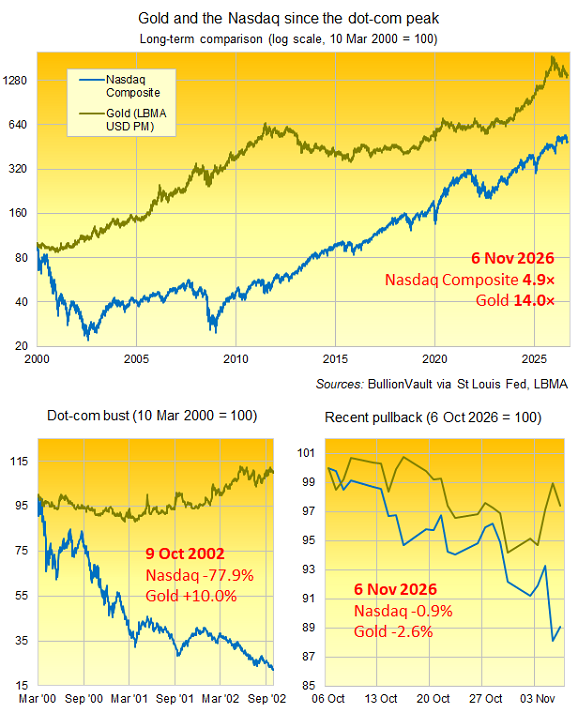
By the close on 6 November, the Nasdaq Composite was 10.9% below its 6 October all-time closing high.
Over the same period, gold fell 2.6% in US Dollar terms, based on the LBMA's London afternoon auction benchmark.
Gold also fell in the early stages of the Dot-Com bust in 2000, though by far less than the Nasdaq Composite.
In the 5 weeks after New Year's tech-stock index peaked on 10 March 2000, the Nasdaq fell 34.2%, while gold slipped 2.8%.
By the time the Nasdaq Composite reached its Tech Crash closing low on 9 October 2002, the index was down 77.9% from its peak, while gold traded 10.0% above its level on 10 March 2000.
Spot gold prices for London settlement today rose as much as 2.1% to $4134 per troy ounce in early Asian trading, peaking below Friday's near-3-week high before easing to $4085 and then rising again to $4115 by lunchtime in the UK, some 1.6% above Friday's afternoon auction price.
The Dollar Index – a measure of the US currency's value versus its major rich-world peers – slipped 0.4%, curbing the gains in gold for UK and Euro investors.
Brent crude oil meanwhile fell 2.0% to $96.29 a barrel as traders weighed diplomatic efforts to end the US-Iran conflict, extending last week's 16% drop, its steepest since the Covid Crash of April 2020.
Most Asian stock markets rose on Monday, with Japan's Nikkei 225 gaining 2.3% for its first rise in six sessions. But South Korea's tech-heavy Kospi fell 0.8% to its lowest close since 2 February, leaving it 44.9% below its June record high, even as Samsung Electronics and SK Hynix edged higher.
Nvidia shares fell 4.5% in premarket trading after the company responded to media reports of an extra-marital affair by opening an internal investigation into whether CEO Jensen Huang had been targeted by a foreign intelligence 'honey trap' operation.
Finding increasing demand from the electrical and electronics industries, silver today rose as much as 2.8% to $53.46 per troy ounce before easing to $52.64, still 1.2% above Friday's London auction price.
Silver prices gained 3.8% last week, recovering from a nearly 13-month low in US Dollar terms, but fellow electrical-and-electronics metal copper fell 2.7% on the London Metal Exchange, rallying on Monday as investors weigh the risk of a slowdown in US or European data centre construction.
LME three-month copper has now lost over 7.0% since hitting a record $14,875 per tonne on 10 September.










 Email us