
Non-Investment Gold Demand Collapses at Record Prices
Investing in gold now beats jewellery buying in 2/3rds of the world...
NEW DATA says that non-investment demand for gold collapsed at the start of 2026 as prices spiked to record highs above $5000 per ounce, led by the weakest jewellery buying since the Covid Crisis.
Gold investing in contrast held strong by weight, setting a fresh record high by net value and extending the shift away from gold for adornment to gold for investment already seen in top consumers China and India since 2024.
According to BullionVault analysis of the new figures, global jewellery demand plus technological use fell to barely 50 tonnes in January-to-March net of scrap sales and recycling. That marks the lowest quarterly total on current records outside the global pandemic lockdowns of 2020.
Net demand for gold coins and bullion bars on the other hand, plus inflows to gold-backed ETF trust funds and the estimated growth in bullion reserves among central banks, totalled almost 780 tonnes according to this week's Q1 2026 figures from the mining industry's World Gold Council.
That's in line with last year's 3-month average by weight, and it comes two-fifths above the 2020s' quarterly average to date.
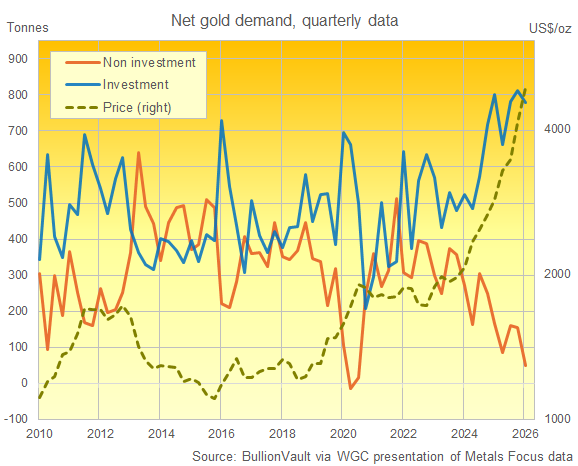
Before accounting for consumer selling, "Jewellery demand sank to its lowest quarter since Covid," says the World Gold Council's report, presenting data gathered and analyzed by specialist consultants Metals Focus.
But by value, that gross demand for jewellery worldwide "increased 31% year-on-year to US$47bn – a record first quarter spend on gold jewellery."
Recycling flows, however, topped that headline figure for jewellery purchases by $10bn, setting a series record by value on data back to Q1 2010 and marking the heaviest scrap supply by weight since Q3 2020.
Productive use meanwhile set a new record by value near $13bn, almost unchanged by weight from the past decade's quarterly average.
"In addition to high prices," says a recent note from Metals Focus on world No.1 gold consumer China's jewellery market, "competition from consumer spending on tourism and entertainment, lower disposable incomes, and a preference for lighter pieces all resulted in notably lower sales...[as did] a lack of aggressive sales targets set by retail brands.
"By contrast, gold investment surged," Metals Focus says of China, with retail gold investment already overtaking jewellery consumption for the first time on record across last year after a "shift from quasi-investment jewellery to gold bar purchases had already begun in 2024."
Of the 32 individual nations tracked by the WGC's current data series, only 6 saw net coin-and-small-bar demand outrun gross jewellery demand in 2010.
That number then rose to 8 amid the gold price crash of 2013 and reached that number again during the globally weak household consumption of 2019 and the Covid lockdowns of 2020, when the gold-investing nations of Thailand, Vietnam, Turkey, Germany, Switzerland and Austria were joined by Taiwan and South Korea.
Now in the 2020s to date, the number has since risen to reach 16 out of 32 in 2025 before leaping to 22 in the first quarter of this year and including giant consumers China, Iran, Turkey and the USA as well as Australia, Japan, Indonesia, Malaysia, Singapore, Russia, Egypt the UK and Canada.
"Gold bar and coin sales...boomed" in China in Q1 says Ray Jia, WGC head of research Asia Pacific ex-India, "supported by global and region geopolitical risks, the strong gold price momentum, and the fact that jewellery consumers with investment motives moved to bullion as gold jewellery now faces additional VAT burden" from a change in sales tax rules for purchases made through the Shanghai Gold Exchange.
For jewellery sales worldwide, in contrast, "Demand was strangled by the price rise to record highs in January," says the WGC's new Gold Demand Trends., and "even after its subsequent correction, gold remained above prior historical levels."
Across the first 3 months of 2026, global gold prices averaged nearly $4873 per Troy ounce, rising 70.4% from Q1 last year with the fastest annual jump since Q3 1980.
Looking ahead, "Investment demand is likely to underpin India's gold market," says WGC research head for the subcontinent Kavita Chacko of the world's 2nd largest gold consumer nation, "even as jewellery demand remains under pressure from economic and inflationary headwinds."









 Email us