
China's Gold Investing Outweighs Jewelry 2.5x
Gold investment soars, adornment demand hits record low...
GOLD INVESTING in China soared in the first half of 2026, with total demand for the precious metal setting a fresh record by value at new record prices as bar-and-coin buying more than offset a fresh plunge in jewellery purchases, writes Atsuko Whitehouse at BullionVault.
Latest figures from the China Gold Association (CGA) say that, overall, private-sector gold demand in the No.1 gold consumer nation rose 1.2% year-on-year in January to June 2026 by weight, reaching 511.4 tonnes, worth a record 530.5 billion Chinese Yuan (US$77bn).
Within that number, retail bar and coin demand outweighed jewellery demand 2.5 times over, leaping 28.4% from H1 2025 to 339.3 tonnes as gold in the form of rings, necklaces and bracelets slumped 33.9% to 132.1 tonnes according to BullionVault calculations based on the CGA data.
This split − away from gold for adornment towards gold investment − was first identified by BullionVault more than 2 years ago, when gold prices began setting new record highs through to this New Year's fresh all-time gold price peak.
2026's dramatic dominance of gold for investment over adornment is confirmed by separate numbers from specialist analysts Metals Focus.
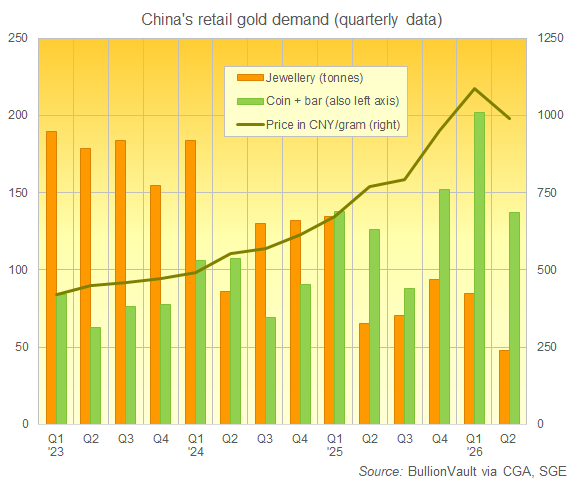
Published by the mining industry's World Gold Council, their latest data put China's jewellery demand in April-to-June down 27.7% from Q2 last year to just 50 tonnes, the lowest ever quarterly figure on the WGC series starting in 2010, and lower even than the Covid lockdowns crash of 2020.
China's retail gold bar and coin demand, in contrast, rose 8.7% per year last quarter to 137.3 tonnes, almost three times jewellery demand on Metals Focus' figures.
This shift has taken place against a sharp rise in global and domestic Chinese gold prices. The quarterly average Yuan gold price climbed from CNY420 per gram in Q1 2023 to a record CNY1,088 in Q1 2026, an increase of 159%, before falling 9% quarter-on-quarter to CNY990 in Q2.
The first quarterly decline since Q3 2023, that still put China's average gold price across the first 6 months of 2026 at a new half-year record above 1037 per gram. That compares to average household disposable income of 3,614 per month in 2025 on latest data from China's National Bureau of Statistics.
Away from retail gold products, China's exchange-traded funds backed by gold saw record monthly outflows in June according to separate data compiled by the World Gold Council. But since the start of January, gold ETFs in China still attracted net inflows of CNY40 billion ($5.6 billion), equivalent to 29 tonnes of gold, in the first half of 2026, marking the second-strongest H1 performance on record.
More recently, Chinese gold ETFs recorded 14 consecutive trading days of inflows through early August, the longest streak since March, attracting more than $1.2 billion as investors returned to gold amid increased volatility in Chinese equities.
China's government demand has also remained strong, with the People's Bank of China adding 20 tonnes to its official gold bullion reserves in July, the largest monthly increase since October 2023. The central bank added 40 tonnes during the first half of 2026 through steady monthly purchases, including 8 tonnes in April, 10 tonnes in May and 15 tonnes in June, as gold prices retreated during the initial global shock of the US-Iran war.
Official-sector interest in gold has extended elsewhere in Asia, with the Bank of Korea returning to gold investment for the first time in 13 years, holding 679,765 shares of the US-listed SPDR Gold Trust worth $250.4 million at the end of Q2.
Asian governments are also reshaping the region's bullion-market infrastructure. Hong Kong in July launched trial operations of a new centralized clearing and settlement system for wholesale gold transactions, creating the new HAU reference price following Singapore's announcement in June that it will establish its own OTC gold clearing system by the end of 2026.
India, the world's second-largest gold consumer after China, has also seen jewellery demand shrink again as investment grows. With no domestic gold-mining output, and even with Rupee prices also hitting new all-time highs so far this year, the New Delhi authorities continue to raise the cost of buying gold to try curbing bullion imports, making certain gold imports subject to the 3% Integrated Goods and Services Tax (IGST) in April, followed by an increase in India's gold import tariff from 6% to 15% in May.
Net gold imports fell 23% year-on-year to 98.1 tonnes in Q2, according to the World Gold Council, their lowest quarterly level since Q3 2020, while overall gold demand declined 6% to 131 tonnes. But within the first-half figures, bullion bar-and-coin demand rose 21.3% year-on-year to 112.5 tonnes in January to June, the strongest first-half total in 13 years, while gold ETF demand more than doubled to 23.5 tonnes from 9.0 tonnes a year earlier.
India's jewellery demand, in contrast, shrank 17.1% by weight to 141.2 tonnes. Gold import values then rose again in July, increasing around 5% year-on-year to help take India's merchandise trade deficit to a six-month high of $31.98 billion.
"Investment is expected to be the principal source of demand growth through the rest of 2026, supported increasingly by OTC activity and Asian buying," says the WGC's latest Gold Demand Trends report.









 Email us