
Gold Price Struggles as Stocks Hit New Record Highs Despite Iran War
GOLD and SILVER PRICES recovered most of an earlier loss on Monday only to drop back again as global stock markets pushed up towards new all-time highs despite oil prices rising with long-term interest rates as the Strait of Hormuz stayed shut, writes Atsuko Whitehouse at BullionVault.
With the US-Iran ceasefire looking increasingly fragile, spot gold prices fell as much as 0.7% in Asian trade before briefly reversing that loss only to drop back again through $4700 per Troy ounce following the 'safe haven' metal's first weekly loss in four.
Tokyo's Nikkei 225 in contrast reached a new all-time closing high, breaking the 60,000 mark for the first time, and European bourses then followed Asian stock markets higher, with the pan-European Stoxx 600 up 0.3%.
S&P500 futures said the major New York index of US stocks would open the week flat having gained 13.0% from its end-March low and rising 4.2% since the Iran War began at the end of February.
The S&P500 has now recorded 7 new all-time highs this year, 4 of them since the conflict began.
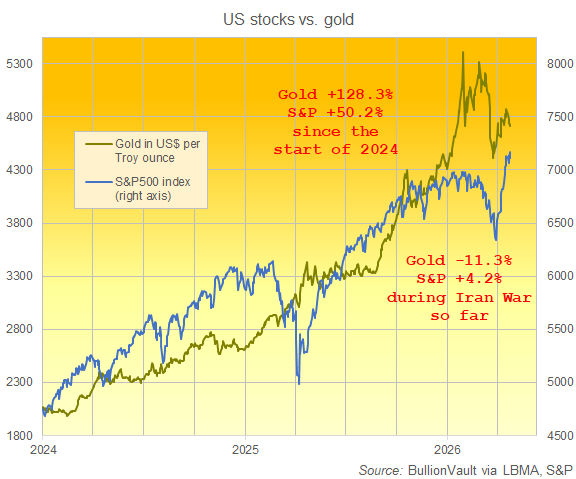
"The gold recovery has massively lagged equities, with the S&P500 showing an uncomfortable divergence," says Nicky Shiels, head of metals strategy at Swiss bullion refining and finance group MKS Pamp.
"Gold is a poor risk asset...[and] as long as equities and earnings outperform, they remain the preferred debasement trade outside of a hard catalyst around the US fiscal/debt trajectory."
Tehran at the weekend gave Washington a new proposal to reopen the vital shipping lane in exchange for the US lifting its blockade of Iranian ports, seeking an end to hostilities before discussing Iran's nuclear program.
But United States President Donald Trump − targeted Saturday by a 'lone wolf' assassination attempt − cancelled his top envoys' trip to Islamabad this weekend for peace talks, while Iran blamed the "excessive US demands" for the failure to progress as the Middle East war approaches the start of its third month.
Crude oil rose this morning, with Brent crude increasing as much as 2.8% to $108 per barrel, extending its gain to 44.1% since the start of the conflict.
Interest rates in the bond market also rose again, taking 10-year US Treasury yields back above 4.30% per annum as comparable German Bund yields topped 3.00% and UK Gilt yields reached 4.93%, nearing last month's touch of the highest since the financial crisis of 2008.
Prices for silver, primarily an industrial metal that derives nearly 60% of its annual demand from productive uses, today fell as much as 1.3% before recovering all but 25 cents of that loss by lunchtime in London at $75.50 per Troy ounce.
The grey metal has fallen 16.8% since the Iran conflict started, while the price of gold in Dollar terms has dropped 11.3%.
Major AI-driven US companies including Microsoft, Alphabet, Amazon, and Meta will release their latest quarterly earnings reports this week.
The Philadelphia Semiconductor Index continued its rise for an 18th consecutive session last Friday, bringing its total gain to 28.3% since the Middle East conflict began.
"There's a lot of risk out there, and yet asset prices are at all-time highs," warned Sarah Breeden, Deputy Governor for Financial Stability at the UK's Bank of England last week, pointing to the Iran War's oil-price and macroeconomic shock, plus weakening confidence in private credit and a possible rerating of AI and other high-risk stock market valuations.
"We expect there will be an adjustment at some point."
The Bank of England will announce its latest monetary policy decision on Thursday, alongside the European Central Bank, while the Bank of Japan begins on Tuesday, followed by the Bank of Canada and then the US Federal Reserve on Wednesday.
All five majors are widely expected to keep policy rates unchanged.
"[Precious metal] investors have remained cautious amid an uncertain macroeconomic and geopolitical environment," says a note from Chinese bank and London bullion clearer ICBC.
"It seems that many market participants have decided to take a 'wait-and-see' approach," agrees Bruce Ikemizu, chief director of the Japan Bullion Market Association, pointing to gold's narrowing trading range and lower trading volumes compared with the dramatic year-end and New Year period of relentless gold price records.









 Email us