
Gold Cuts 3.5% Drop in Half as Bond Market Smells Stagflation
GOLD and SILVER PRICES rallied hard late Friday in London as the Iran War's oil-price shock saw inflation expectations rise faster than interest-rate forecasts, signaling stagflation fears ahead of next week's slug of central bank decisions, including Wednesday's meeting of the US Federal Reserve.
Industrially-useful silver rallied to touch $76 per Troy ounce after falling to its lowest in almost 2 weeks, bottoming last might 2 cents below $74.
The price of gold in US Dollars meantime peaked just below $4740 per Troy ounce, almost halving this week's previous $170 plunge to 9-session lows, as the so-called "real rate of interest" on US Treasury bonds fell to its lowest in 5 weeks.
Caught between surging inflation and slowing growth − a combination first termed "stagflation" in the 1960s and popularized during the oil crises of the 1970s − "Central bankers face an unenviable task next week," says a note from Dutch bank ING, looking ahead to decisions from Japan, Canada, the Eurozone and UK Bank of England as well as the Fed.
"Markets are bracing for rate hikes, yet the case for action is far from clear-cut."
US consumers now see inflation 1 year from now surging from March's 3.8% forecast to 4.7% this month − the steepest jump since last April's 'Liberation Day' trade tariffs chaos − according to Friday's new sentiment survey from the University of Michigan.
Bond traders meantime hiked the "break even" inflation rate implied by US Treasury debt prices to the highest since early September on Friday, with conventional 10-year yields trading at 4.30% as inflation-protected TIPS yields fell to 1.88% per annum.
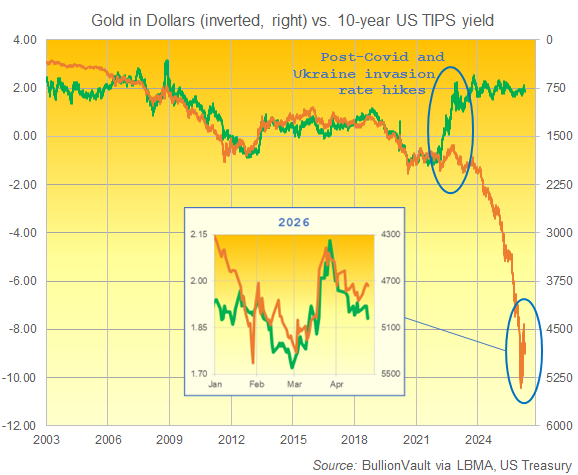
That real yield, over and above inflation, showed a strong correlation against the price of gold until the post-Covid and Ukraine-invasion inflation of 2021-2022 saw central banks hike overnight borrowing costs sharply.
But that relationship − after breaking down again at the end of 2025 − has now returned in 2026 so far, with higher real rates coinciding with falls in the gold price since the Iran War began 8 weeks ago tomorrow.
"Gold prices have retreated amid expectations that interest rates will remain higher for longer," says a note from Chinese bank and London bullion clearers ICBC.
"Selling pressure is persisting as real yields stay elevated."
Betting on when the Federal Reserve will next cut US interest rates today put September 2027 as the first most likely date, according to data from the CME derivatives exchange.
Back on the eve of the US-Israeli war on Iran, with gold trading above $5000, the market put almost a 60% chance on the Fed resuming its cuts this June.
"Futures markets are still materially underpricing the real supply risk facing both crude oil and natural gas," says a note from Rabobank in the Netherlands.
"An inflation shock seems unavoidable now...The longer the conflict in the Middle East remains unresolved, the bigger the stagflationary impact will be."
Yesterday's "flash" PMI surveys said business input costs are surging worldwide, with services sector activity in the 21-nation Eurozone − the world's 2nd largest economic bloc, just ahead of China − contracting at the fastest pace since the region's 2021 Covid pandemic lockdowns.
Crude oil prices today dipped back towards $100 per barrel of Brent as Tehran said its Foreign Minister Abbas Araghchi will visit Islamabad in Pakistan for "consultations" this weekend despite the USA cancelling its peace-talks delegation.
Asian stock markets fell and European bourses showed a 1.8% loss for the week following yesterday's dire PMI reports. But New York's S&P500 edged back up towards Wednesday's new all-time high.









 Email us