
Gold and Silver Rise with Crude Oil as Iran War Escalates, AI Tech Debt Hits Headlines
GOLD and SILVER rallied further from last week's 8-month lows on Tuesday despite crude oil prices rising further as the US-Iran war escalated again and $1.6 trillion in off-balance-sheet AI tech debt owed by the giant US hyperscalers grabbed the investment headlines.
Gold briefly topped $4080 per troy ounce before dropping $35, while silver prices also hit 1-week highs above $59 before retreating by $1.
Brent crude's most active futures contract meantime rose back above $90 per barrel for the first time in 6 weeks.
"There is no room for complacency on oil security amid the escalation in hostilities," warned the International Energy Agency after the US struck Iran for the 10th day running while Tehran hit infrastructure in US allies Jordan, Bahrain and Kuwait and also attacked 2 oil tankers in the Strait of Hormuz.
Since US President Trump declared the tentative 'peace deal' memorandum of understanding with Iran to be "over" on 8 July, the price of Brent has jumped by 21.7% while gold bullion has lost 2.4%.
But rising together, the price of gold moved in the same direction as crude for the 4th session running, the longest such stretch since late-May − back when September Brent futures were last above $100 per barrel − and contrasting with the oppositional pace of 2-in-3 recorded between March's start to the Iran war and the end of last month.
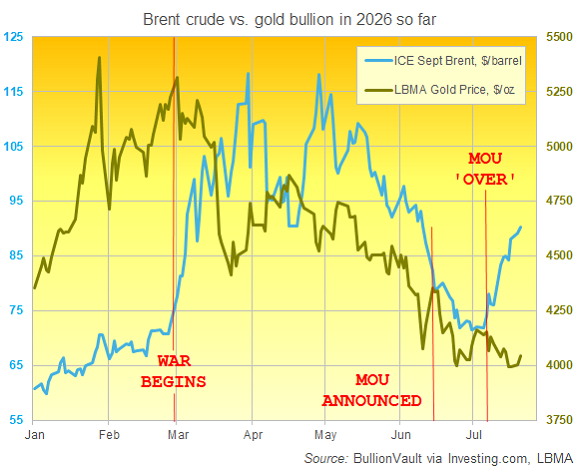
"Gold is showing a relatively muted reaction to the spike in oil prices, which to me reflects some investor apathy around geopolitics," Bloomberg quotes one analyst.
Oil prices would be higher, the IEA said today, if it weren't for increased crude oil output from major Gulf producers Saudi Arabia and the UAE, as well as from the USA and Brazil.
China has also played an "important role in stabilising markets" by drawing down its crude stockpiles and thereby slashing oil imports in half. But "markets for refined oil products, including diesel and gasoline, are considerably tighter than those for crude," the agency warns.
Elsewhere Tuesday, Japan's leading financial newspaper The Nikkei put hard numbers on the size of off-balance-sheet obligations at US tech giants Alphabet, Microsoft, Amazon, Meta, and Oracle through their rush to build AI capacity, rising 8-fold in 4 years to $1.6 trillion owed on contracts and leases for GPU processing units and data center rent.
That tops the five hyperscalers' on-balance-sheet debt by $0.3 trillion.
While Facebook owner and operator Meta (Nasdaq: META) is the heaviest such debtor, software and services provider Oracle (NYSE: ORCL) is most exposed, analysts say, after its long-term credit was downgraded to near-junk bond status by ratings agency S&P earlier this month.
With gold bullion showing a 12-month rise of 19.6% today − just behind AI chipmaking giant Nvidia (Nasdaq: NVDA) at 20.4% − Oracle has now lost half its stock-market value since this time last year. But it rallied 3.7% at Tuesday's opening as competitors' shares also stemmed the recent AI tech stock slump.
"The server replacement cycle in AI data centres is now 18-36 months," says Electronics Weekly, "with a new generation of accelerator chips coming out every 18 months. To keep at the leading edge, the investment is endless."










 Email us