
Gold and Silver Jump as Weak Jobs Data Crushes Fed Rate-Rise Bets
GOLD and SILVER PRICES leapt on Thursday as weaker-than-expected US jobs data − released on the eve of America's 250th Fourth of July celebrations − crushed betting that the Federal Reserve is about to raise Dollar interest rates to try stemming inflation.
June's net addition to non-farm payrolls came in at 57,000 per month − barely half Wall Street's consensus forecast and the worst reading since February's 156,000 drop.
US Treasury bond prices rallied, edging longer-term yields lower, as betting sank that the US central bank will raise interest rates at its end-July meeting.
The chances of a September rate rise also dropped, falling to barely an evens shot according to market pricing tracked by the CME derivatives exchange's FedWatch.
It peaked as high as a 75% certainty in the immediate aftermath of new chairman Kevin Warsh's first meeting in charge of the Fed a fortnight ago, which ended with "no change" but also "hawkish" comments about inflation.
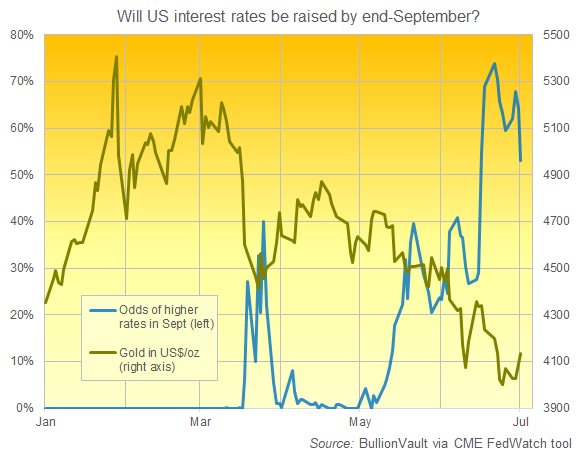
Having swung by more than $100 per troy ounce on both Tuesday and Wednesday in highly volatile gold trading, the price of bullion fixed at London's 3pm benchmarking auction around $4133 per troy ounce, erasing all but $18 of the past 2 weeks' previous $200 plunge to 7-month gold lows.
Silver meantime jumped to touch $62 per troy ounce, its highest spot market price since Wednesday last week, before cutting its 3.8% surge on today's US jobs data to 2.4%.
"Redemptions have continued to dominate" in silver-backed exchange traded trust funds, says analyst Rhona O'Connell at brokerage StoneX, noting that outflows of investment cash from silver ETFs have now shrunk the sector's bullion holdings by around 1/10th from the 4-year high reached at the end of 2025.
Giant gold ETF the SPDR Gold Trust (NYSEArca: GLD) expanded very slightly on Wednesday from needing 1,005 tonnes of bullion backing, the least in over 9 months and 8.7% smaller than end-February's post-pandemic peak − reached on the eve of Israel and the USA starting their war on Iran.
"The secular trade is intact," says precious metals strategist Nicky Shiels at Swiss bullion refining and finance group MKS Pamp.
"Gold's secular upside hinges on a geo-macro regime of 'expect the unexpected' and last we checked, Trump is still president, a strong US Dollar is very destabilizing for the rest of the world, China is arming for Trade War 2.0...and silver and the platinum group metals have just been reclassified as critical/strategic metals by growing number of countries."
Together with gold and silver, the price of platinum and palladium also jumped on Thursday's NFP jobs data, rising near 1-week and 2-week highs respectively at $1638 and $1280 per troy ounce.
European stock markets also jumped as the Dollar sank to 2-week lows versus the Euro, but Japan's Nikkei had earlier closed sharply lower after the Yen rebounded sharply from 4-decade lows to the US currency amid what traders and analysts suspected was FX market intervention by the Bank of Japan or Ministry of Finance.
US tech stocks then tumbled again, following the latest plunge in South Korean giants Samsung and SK Hynix with AI chipmaker Nvidia (Nasdaq: NVDA) now losing 17.0% from mid-May's record high.
Crude oil meanwhile fell despite US-Iran peace talks breaking up without a deal over the Strait of Hormuz, falling below $71 per barrel of Brent for September settlement for the first time since 27 February, eve of the US-Israeli war on Iran and down by 1/3rd from mid-May's 4-year highs.
Back in central banking, Warsh yesterday "led a retreat" from offering forward guidance to financial markets among European policy chiefs including the ECB's Christine Lagarde and Bank of England chief Andrew Bailey at the annual monetary policy summit in Sintra, Portugal.
This time last month, May's stronger-than-expected non-farm payrolls data pushed gold and silver prices down below their starting point for 2026.
Year-on-year, today's non-farm payrolls data said employment growth rose above half-a-million in June for the first time since last September, while the unemployment rate slipped to the lowest in 12 months at 4.2% and average wage growth accelerated 1 tick to 3.5% per annum.









 Email us