
Gold Slips on Fed Rate Fears as China's Russian Gold Imports Surge
GOLD and SILVER PRICES fell on Monday as traders raised bets that the US Federal Reserve will raise interest rates at next week's policy meeting while data from China showed a surge in gold bullion imports from Russia, blocked from Western markets since 2022 by sanctions over its now 4-year war in Ukraine, writes Atsuko Whitehouse at BullionVault.
Down 1.2% on Friday after strong US jobs data raised the market-priced odds of a September rate rise to nearly 3-in-5, spot gold in London today fell as much as 1.0% to $4385 per troy ounce before rallying back through what some analysts call the "key" $4400 level.
Silver, which finds nearly 60% of its annual demand from industrial uses, meanwhile fell as much as 1.2% on Monday to $65.42 per ounce.
"That gold is sitting within 6% of its [record New Year] highs with the Fed openly debating a hike − not a cut − tells you everything about what's actually bid here," says Nicky Shiels, head of metals strategy at Swiss bullion refining and finance group MKS Pamp, contrasting today's 'bearish' interest-rate expectations with 'bullish' geopolitical headlines.
While Russia's war-crime accused President Putin last week met China's President Xi as well as US President Trump's son-in-law and special envoy to discuss his ongoing war in Ukraine, data from Hong Kong said that Russian gold imports into the Chinese city already set a full-year record just 7 months into 2026.
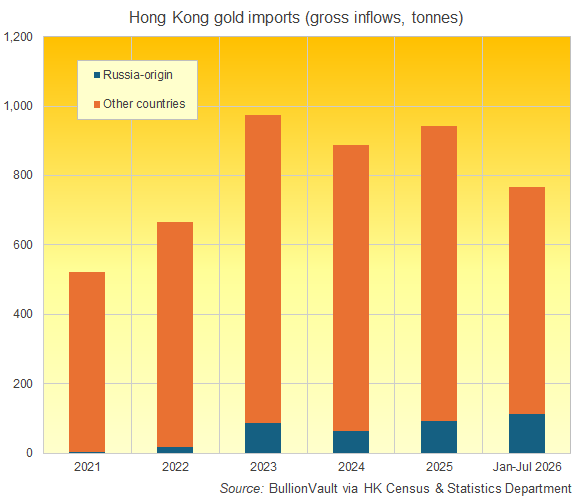
BullionVault analysis of trade data published by the Hong Kong Census and Statistics Department (C&SD) says Hong Kong imported just 3.3 tonnes of Russian-origin gold in 2021, eve of Putin's all-out war on Ukraine and the resulting Western sanctions, equivalent to 0.6% of the Chinese gateway's total non-monetary gold imports.
Rising to a record 92.1 tonnes in 2025, those imports then totaled 112.7 tonnes between January and July this year, accounting for 14.7% of Hong Kong's reported gold inflows.
"Russian gold floods through Hong Kong in wake of western sanctions," said a Financial Times story at the weekend − "a 'consequence of the Russia-China economic relationship', whereby Moscow sells resources to Beijing in exchange for economic support," the FT says, quoting geopolitical consultant Vita Spivak at UK advisory Gatehouse.
Widely put around 300-350 tonnes per year, Russia's gold mining output jumped towards 500 tonnes last year according to Natural Resources Minister Alexander Kozlov in June.
None of that metal is now allowed into London's professional market after trade association the LBMA on 7 March 2022 suspended all six Russian gold and silver refiners previously approved for its Good Delivery Lists, effectively excluding their new production from the centre of the world's physical bullion trade.
The surge in Russian shipments to Hong Kong is part of a broader increase in bullion flows through the city, with nearly 766 tonnes of non-monetary gold over the first 7 months of 2026 putting it on course to surpass the recent annual high of 974 tonnes recorded in 2023.
June alone saw imports of more than 150 tonnes, the highest monthly volume in more than a decade. Including Hong Kong, where a new gold clearing system has been established as neighboring Singapore also launches gold clearing, total gold inflows to China − the precious metal's No.1 mining, importing, consumer and central-bank gold buying nation − reached around 1,000 tonnes between January and July according to global asset management giant State Street.
The People's Bank of China reported on Monday that its gold bullion reserves rose by 20 tonnes in August to 2,387 tonnes, marking 22 consecutive months of additions.
Gold on the Shanghai Gold Exchange traded at a premium of $5.87 per troy ounce to London prices today, reversing Friday's discount as the Yuan gold price fell 1.5% to CNY 949.09 per gram.
Oil prices meantime rose 1.7% to peak near a 3-month high of $97 per barrel of Brent after renewed US-Iran fighting around the Strait of Hormuz and wider Middle East.
The Dollar index – a measure of the US currency's value versus its major peers – fell 0.2% as the Japanese Yen rose 1.3% to ¥154 against the US Dollar, its strongest since February and above the level reached after the US-Japan joint intervention in late July.
US financial markets, including Treasury bonds, are closed for Labor Day, thinning liquidity while foreign-exchange markets remain open.
The Fed has now entered its 'blackout period' for comment ahead of the September 15 to 16 meeting.









 Email us