
Gold Pares Gains after Weak US Jobs Data, ETF Demand Resilient Despite High Bond Yields
GOLD PRICES rose on Friday after the weaker-than-expected US jobs report pushed bond yields and the Dollar lower, before giving back much of those gains. Despite long-term US interest rates remaining near multi-decade highs amid concerns over elevated government debt levels, gold has continued to trade at historically high levels, supported by resilient investment demand, including continued inflows into gold-backed ETFs, writes Atsuko Whitehouse at BullionVault.
Spot gold rose 0.9% to $4216 per ounce immediately after the data, before giving back much of the advance later in the session. The move initially reduced its weekly decline to 1.1%. That still left gold around the level of what was then its all-time high, reached in December 2025. The yellow metal fell 8.5% in September as the Dollar rallied and crude oil prices rose.
The Dollar index – a measure of the US currency's value versus its major peers – edged lower on Friday following the release of the US jobs report, after rising 1.75% in September. Ten-year US Treasury yields – a benchmark rate for government as well as many finance and commercial borrowing costs – also fell following the data, retreating from Thursday's 24-year high of around 5.35%. The benchmark yield had risen 53.5 basis points, or 11.2%, during September.
Real interest rates also rose sharply, with 10-year TIPS yields posting their steepest monthly rise in four years in September.
“With the blowout in US yields and the US$, a regression model says gold should be much lower,” said Nicky Shiels, Head of Research & Metals Strategy at MKS PAMP SA, adding that its actual “debasement premium” is around $840/oz.
In September, holdings in SPDR Gold Shares (NYSEArca: GLD) and iShares Gold Trust (NYSEArca: IAU), the world’s two largest gold ETFs, both increased for the first time in the same month since February. GLD holdings rose by 13.3 tonnes (1.3%), marking a third consecutive monthly increase, while IAU holdings increased by 3.0 tonnes (0.7%), their first monthly gain since April.
These modest inflows have continued into October, with GLD and IAU holdings rising by 0.2% and 0.1%, respectively, so far this week through Thursday.
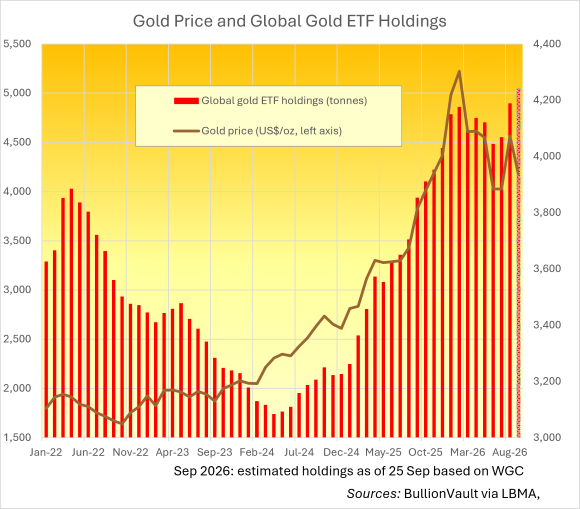
The resilience in ETF investment demand was also evident globally. World Gold Council data show that global gold ETF holdings had already reached a record 4,189 tonnes at the end of August. Global gold ETFs then saw net inflows of roughly 52 tonnes in the four weeks to 25 September, indicating that holdings remained at record levels despite the sharp rise in bond yields and the pullback in gold prices during the month.
“September produced a striking divergence between gold and investment demand,” said derivatives platform Saxo Bank’s commodity strategist Ole Hansen.
“The continued inflows suggest investors were looking beyond the immediate headwind from higher real yields and instead focusing on what those higher borrowing costs may ultimately mean for fiscal sustainability and already elevated government debt levels,” Hansen continued.
Concerns over France’s fiscal position intensified this week after the government presented its 2027 budget, which includes spending cuts and tax increases aimed at reducing the deficit. France’s public debt reached €3.60 trillion, or 119% of GDP, at the end of the second quarter, while the government plans to issue a record €340 billion of debt in 2027. The budget announcement also came amid nationwide protests and strikes, with demonstrations by students and public-sector workers over planned spending cuts and other grievances, some of which turned violent.
The 10-year French government bond yield rose to its highest level since 2002, reaching 4.96% on Thursday, while the spread over German Bunds widened to its highest level since the Eurozone sovereign debt crisis in 2012.
On the same day, amid broader concerns over inflation and fiscal positions, the UK 30-year gilt yield briefly topped 6% for the first time since 1998, Japan’s 10-year government bond yield rose to around 3.1%, close to a multi-decade high, and Italy’s 10-year government bond yield climbed to 4.69%.
Government debt levels also remain elevated in these economies, with gross government debt at around 100% of GDP in the UK and estimated at around 207% in Japan and 138% in Italy in 2026, according to the IMF.
US nonfarm payrolls rose by just 29,000 in September, well below forecasts of around 90,000, while the unemployment rate edged up to 4.2% from 4.1%. Average hourly earnings also came in weaker than expected, rising 0.1% month-on-month and 3.0% year-on-year, against forecasts of 0.3% and 3.2%, respectively. The August payroll gain was also revised down to 133,000 from the previously reported 162,000, adding to signs of a cooling US labour market.
The weaker data reduced expectations for another Federal Reserve rate hike at its October meeting, with futures markets putting the probability at less than 20% following the release, down from more than 25% beforehand. Markets nevertheless continued to price in more than a 70% chance of at least one further rate increase by December.
Oil prices fell more than 2% on Friday, with Brent crude slipping below $100 a barrel, after reports that European countries were discussing additional releases of diesel and crude oil from stockpiles, while oil flows from the Middle East continued to recover.
This followed a sharp rise on Thursday, when Brent jumped more than 4% to settle above $102 a barrel, after reports that the US was sending a third aircraft carrier and up to 10,000 additional troops to the Middle East as President Donald Trump weighed renewed strikes against Iran. China's suspension of oil product exports added to concerns over tightening global fuel supplies.
Prices for silver, primarily an industrial metal, with nearly 60% of its annual demand coming from industrial uses, also rose 1.1% to $61.87 per ounce immediately after the US jobs data were published, before giving back those gains later in the session. The grey metal fell 13.6% in September. That still left the metal around the level of its then all-time high reached in December 2025.










 Email us