
Gold Reclaims $4000 as Data Show Modest Speculative Retreat Before Latest Sell-Off
GOLD PRICES recovered the $4,000 level on Monday as new data showed eight consecutive weeks of declines in speculative net longs in Comex gold futures and options – a modest retreat relative to gold’s price fall by historical standards, writes Atsuko Whitehouse at BullionVault.
Spot gold traded at $4021 per ounce by Monday lunchtime, up 0.2% from Friday’s London PM auction price, as investors assessed how oil price moves driven by developments in the Middle East could shape rate-hike expectations ahead of the FOMC meeting, while watching how AI stocks would respond to earnings from major technology companies.
Gold fell 4.2% last week, its largest weekly percentage decline since mid-May, to $4013 per ounce at Friday’s London PM auction – its lowest Friday price since 17 July. Spot prices then fell below $4000 later that day and stayed there until Monday morning. Friday’s London PM auction price was 25.75% below the record of $5405 per ounce set on 29 January 2026.
Silver prices meanwhile traded at $54.15 per ounce on Monday, up 0.5% from Friday’s London auction price, after falling 6.6% last week, their largest weekly decline since mid-July. Silver’s greater exposure to industrial demand left it vulnerable to growth concerns after Thursday’s AI-driven sell-off, which saw the Nasdaq fall 2.6% and the Philadelphia Semiconductor Index slump 6.7% amid renewed worries over the scale and financing of AI investment. Silver’s steeper weekly decline pushed the gold-to-silver ratio to 74, its highest since last November.
Asian stocks were subdued on Monday, with South Korea’s chip-heavy KOSPI closing down 1.5%, while China’s CSI 300 edged 0.04% lower. Europe’s STOXX 600 meanwhile rose 0.4% in morning trading following its steepest weekly decline since early September.
“There is no particular trigger for the latest decline,” said Jeff Toshima, former Tokyo director of the mining industry’s World Gold Council and a regular columnist for Nikkei.
“With the FOMC meeting and midterm elections coming into focus, short-term speculators, including CTAs, are squaring their positions. Liquidation to cover losses from the sharp stock market sell-off is also evident,” Toshima continued, adding that US Treasuries and the Japanese yen were attracting safe-haven buying.
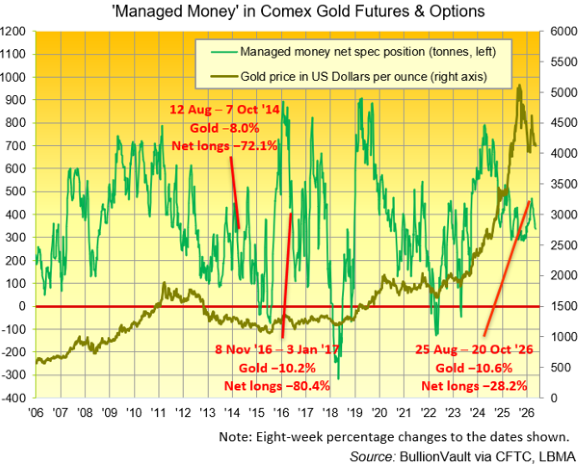
Latest data show that hedge funds and other leveraged speculators – classified as ‘Managed Money’ by US regulator the CFTC – cut their net-long positions in Comex gold futures and options for an eighth consecutive week, down to 338.05 tonnes on 20 October. Over those eight weeks, net longs fell by 132.59 tonnes, or 28.2%, while gold prices dropped 10.6% – a comparatively modest reduction in positioning for a price decline of that size, based on previous extended runs of speculative selling.
The dataset, which begins in June 2006, contains eight episodes of net longs declining for eight or more consecutive weeks, including the current run. Gold prices also fell in four of the seven previous episodes. In those four episodes, net longs contracted by between 72% and 81%, while gold declined between 7.5% and 20.7%. In the other three, gold prices rose or remained steady.
Both the 2014 and late-2016 episodes highlighted in the chart came amid a strengthening US dollar and rising expectations of Fed rate hikes.
Positioning alone, however, cannot explain gold’s performance, and the latest data do not capture the sharp price falls on 22 and 23 October.
Gold ETF flows were mixed last week. Holdings in SPDR Gold Shares (GLD), the largest gold-backed ETF, fell 1.64% to 1,041.65 tonnes – the largest weekly outflow since the week ending 6 March. By contrast, holdings in iShares Gold Trust (IAU), the second largest, were broadly unchanged, edging up 0.03% to 463.05 tonnes.
Brent crude fell 1.6% to $114.82 per barrel on Monday as renewed diplomatic efforts to ease tensions between the US and Iran encouraged profit-taking, following a gain of around 6% last week amid escalating tensions in the Middle East.
“For Gold, oil is working through rates,” wrote Nicky Shiels, head of metals strategy at Swiss refining and finance group MKS Pamp, in her latest report. She said higher crude prices were keeping inflation expectations elevated and reinforcing expectations that central banks would maintain higher interest rates for longer, outweighing geopolitical safe-haven demand last week.
Houthi attacks on Saudi Arabia continued over the weekend, while President Trump said he was considering whether to reach a deal with Iran or resume US military attacks. He had previously said renewed strikes would not take place before the US midterm elections on 3 November.
Markets now price in a less than 10% chance of a rate hike at this week’s FOMC meeting, down from just under 20% a week ago, although the probability of a hike by year-end remains around 80%, according to the CME’s FedWatch tool.
The US 10-year Treasury yield stood at around 4.99% on Monday, after falling towards a one-month low last week, although the decline offered little support to precious metals.
France’s 10-year government bond yield fell back below 5% to around 4.98% on Monday, after Moody’s on Friday maintained the country’s Aa3 credit rating with a negative outlook despite concerns over a possible downgrade, while weekend protests proved less violent than a week earlier. The yield had touched around 5.14% last Thursday—its highest level since July 2002.
Markets face an event-packed week, with Israel’s general election on Tuesday, followed by monetary policy decisions from the Fed on Wednesday, the ECB on Thursday and the Bank of Japan on Friday. Thursday also brings the US PCE inflation report, including the core measure closely watched by the Fed. Alphabet and Microsoft report earnings on Wednesday, followed by Amazon on Thursday, putting AI spending and financing back in the spotlight.










 Email us