
Gold Makes Longest Losing Streak in 3 Decades
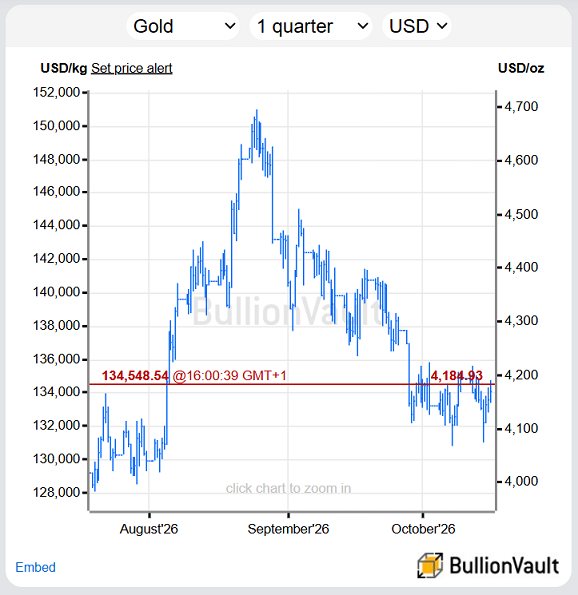
The PRICE of GOLD rallied once more on Friday but failed to regain last week-end's level in London despite interest rates making a steep retreat in the bond market, confirming the precious metal's longest stretch of losses in more than 30 years.
Down $5 per troy ounce from last Friday's 3pm auction to fix around $4185 today, the price of gold has now fallen for 7 weeks in a row in the world's central bullion trading and storage hub.
That matches gold's 7-week drop at the end of 2016, and marks the longest such stretch of losses since the summer of 1996.
"Gold has not benefited from the Middle East shock as much as might have been expected," says UK consultancy Oxford Economics, blaming "higher oil prices [for] inflation concerns [that have] reinforced expectations of tighter US monetary policy, supporting bond yields and the Dollar.
"Nevertheless, central-bank purchases and investor demand continue to underpin prices," says the consultancy's latest commodity price outlook, forecasting average gold prices of $4515 per ounce this year with a 7.2% rise in 2027 and an average above $5000 the year after.
Gold this year has so far averaged $4525, some $200 below the average analysts' gold price forecast for 2026 made at New Year.
Central bank gold demand on official data reached 63 tonnes in September net of sales, preliminary data from the mining industry's World Gold Council says, the heaviest monthly purchases in 2 years.
Gold-backed ETFs have meantime continued to expand even as gold prices have fallen, defying the usual correlation between gold ETFs and the price of bullion.
But consumer demand for retail gold products is weak, with data from the US Mint putting sales on track for the weakest annual total since 2000, when demand slumped 92.0% by weight from 1999 following that year's record-heavy purchases preceding the turn of the millennium.
The past 2 years' drop in US consumers' retail gold demand matches the historic pattern, where US gold coin sales typically slump when there's a Republican in the White House.
The current plunge comes despite silver and gold showing the strongest returns of any major asset class for US investors since the eve of Donald Trump's re-election in November 2024, gaining 76.0% and 52.5% respectively over the past 2 years.
So-called cryptocurrency Bitcoin has risen 17.6% in Dollar terms, while the S&P500 index of major US corporations has paid 38.5% including dividends, and the total return on the tech-heavy Nasdaq 100 index has been 49.8%.
Silver prices meantime fell for the 4th week in a row on Friday, fixing around $57.75 per troy ounce at London's 12 noon auction, its lowest week-end benchmark price since mid-July.
But the US Dollar also fell, down to its lowest so far this month against the Western world's other major currencies and losing 1.2% on its DXY index from Wednesday's fresh 17-month high after US Federal Reserve chairman Kevin Warsh indicated that he won't vote to raise interest rates again at this month's monetary policy meeting.
"I don't believe in saying now what I might do at the meetings that we have in the balance of this year," Warsh told a conference in Bangkok, Thailand this morning, repeating his refusal to give 'forward guidance'.
But following the Fed's September rate rise, Warsh added, "the world has broadly conformed with our expectations over the month or so that's transpired since then."
Betting that the Fed will raise 2 weeks from now sank to price the odds at worse than 1-in-7 having peaking above a 70% certainty at the end of last month.
Global stock markets rallied from this week's Asian and US tech stock crash but still dropped for the week of the past 2 months on the MSCI World Index.
Western government bond prices meanwhile rose for the first week since end-August, pulling 10-year US Treasury yields down almost 1/5th of a percentage point from last week-end's near quarter-century high of 5.26% per annum, the steepest weekly retreat since President Trump's 'Liberation Day' trade tariffs chaos of April 2025.
Crude oil prices continued to hold above $100 per barrel as the Middle East and Russia-Ukraine wars continued, keeping average diesel prices at US gas stations close to late September's new record high above $6.50 per gallon.
"The diesel deal" between Trump and President Putin of Russia, made as the US mid-term elections approach, "will not be the last if we turn a blind eye to it," said Ukraine's President Zelenskyy today at a meeting in Brussels with European Union leaders, urging them to boost their financial and materiel support for Kyiv as Washington demands Ukraine stop striking Russian oil and gas infrastructure.
"The next could be a gas deal, and then it could extend to the banking sector."










 Email us