
Gold Below $4300, Fed 90% Sure to Raise Rates as Oil Jumps
GOLD PRICES fell below the key $4300 level on Monday as crude oil rose toward a year-to-date high, fuelling inflation concerns and pushing year-end US interest-rate expectations to a new high ahead of this week's Federal Reserve meeting, writes Atsuko Whitehouse at BullionVault.
Hitting its lowest in more than 5 weeks, the spot gold price lost as much as 2.4% to $4279 per ounce from Friday's London finish before moving above $4290.
The decline came after the yellow metal fell for a third consecutive week, even though gold rebounded on Friday after US inflation data matched analyst forecasts.
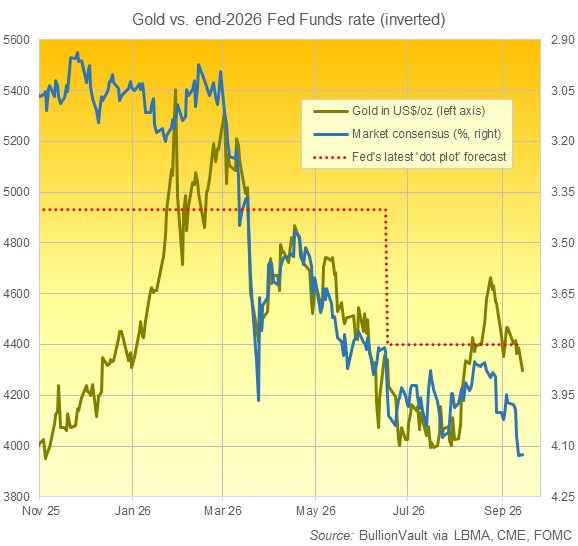
Market forecasts for this Wednesday's US Fed decision now put the odds of a rate rise at 9-in-10, surging from just 1-in-3 this time last month, according to derivatives exchange the CME's FedWatch Tool.
Fed rates are then expected to finish 2026 up again at 4.12 % – implying a further rate rise after September and more than one percentage point higher than the level forecast before the start of the US-Israel conflict with Iran at the end of February.
"The market is carrying [a forecast for rate rises of] 50 basis points over Oct/Dec and close to 100bp over the next year, which looks like a stretch," says Nicky Shiels, head of precious metals strategy at Swiss bullion refining and finance group MKS Pamp.
Rising by 15 basis points over the past 3 sessions, the market's end-2026 US interest rate outlook has made its sharpest such move since the 22bps increase around June's hawkish FOMC meeting.
"This week's Fed meeting may well be the trickiest in years," says economist Mohamed El-Erian, noting that the challenge for US policymakers is less about the economy itself than the sudden shift in rate-hike expectations amid surging bond yields.
That surge has "less to do with the Fed" than with a growing imbalance between demand for bond financing and the supply of capital available to absorb it, El-Erian believes.
Adding to the pressure on new Fed chairman Kevin Warsh ahead of Wednesday's decision, which will also bring new 'dot plot' forecasts for future GDP, inflation and interest rates, US President Donald Trump on Sunday renewed his call for lower interest rates, saying the US "should be paying the lowest interest rate in the world" regardless of what economic data indicate.
Ten-year US Treasury yields − a benchmark rate for government as well as many finance and commercial borrowing costs – today steadied at the highest level since 2007 at 4.97%, sharply above the 4.83% demanded by bond investors before last week's massive buy-back operation by Treasury Secretary Scott Bessent, aimed at boosting prices and pulling yields lower.
The Dollar index – a measure of the US currency's value versus its major peers – rose Monday to the highest level in nearly 2 weeks, helping curb the drop in gold prices for Euro and UK investors at €3707 and £3173 per troy ounce respectively.
Crude oil also rose again Monday, with Brent prices up as much as 2.5% towards $108 per barrel as concerns over Middle East oil supplies intensified after Saudi Arabia shut its key East-West pipeline following drone attacks, while Iran-aligned Houthi forces tightened their grip on shipping routes near the Red Sea.
A meeting between Iran and Gulf states scheduled for Monday to discuss shipping through the Strait of Hormuz was also postponed.
Global stock markets meanwhile fell today, with South Korea's technology-heavy Kospi index dropping 3.3% and Nasdaq 100 futures sinking 1.8%, following weekend calls from some of the world's leading AI executives to slow the development of their most advanced models amid growing safety concerns.
The price of silver, primarily an industrial metal, also fell below Monday, dropping through $63 before regaining that level by London lunchtime.









 Email us