
Gold, Silver Jump After Fed Rate Rise as Oil Sinks, UK Backs Banknotes with Debt
GOLD and SILVER PRICES leapt in London trading on Thursday, rising as much as 3.4% and 5.2% from the new 6-week lows hit yesterday when the US Federal Reserve raised Dollar interest rates, as oil prices sank and government debt prices jumped, pulling long-term borrowing costs down sharply from new multi-decade highs.
Gold hit $4380 per troy ounce and silver peaked above $66 for the first time in a week, rising even as the US Dollar held close to last night's 6-week highs on the currency market after the Fed's new 'dot plot' projections said the policy-making committee now expects to raise rates again before year-end, matching the market's forecast.
The UK's Bank of England in contrast kept its short-term interest rate on hold today and confirmed that it will dramatically reduce the scale of 'quantitative tightening', selling fewer UK government Gilts because the debt will now be used to back the value of Sterling banknotes on its balance sheet.
Pulling 10- and 30-year Gilt yields sharply lower from this week's new multi-decade highs, the news means "£120bn of the longest-dated gilts will therefore no longer be held for monetary policy purposes and so will not be unwound as part of QT," says UK Chancellor John Healey in a public letter approving the Bank's decision.
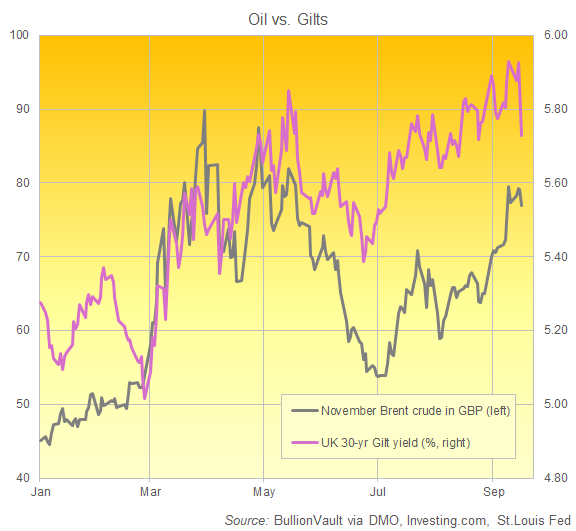
The UK's 30-year Gilt yield today fell by 13.5 basis points from Wednesday's finish, the 3rd steepest 1-day drop of 2026 to date.
Brent crude, priced in UK Pounds, meantime fell 2.8%, a daily drop beaten 30 times so far this year, after Bloomberg reported that Saudi Arabia will re-open its crucial east-west flows through the Petroline before the start of next week.
"Global oil prices could hit highest levels in months after Saudi pipeline attacks," said a New York Times headline yesterday.
But that pipeline − enabling Saudi Arabia to export crude oil without shipping it through the Strait of Bab al-Mandeb now controlled by Iran-backed Houthi forces in Yemen − is now set to re-open "within days".
"Let's see if a hike could open SOH or produce a single barrel [of oil]," tweeted the Speaker of Iran's Parliament M.B.Ghalibaf last night after the US Fed raised Dollar interest rates by 0.25 points as expected.
Trolling the US central bank with a new version of the Taylor Rule which it uses to judge interest-rate policy, Ghalibaf posted a new equation including a "risk premium" for both the Strait of Hormuz and Bab al-Mandeb.
The US Dollar today curbed its strong rally on the FX market starting last Tuesday, edging back from last night's 6-week high on its trade-weighted DXY index against the world's other major currencies.
The Pound lost over 1 cent and the Euro 0.8c to hit near-6 week lows, helping boost gold prices for UK and Euro investors to 9-session highs at £3273 and €3810 per troy ounce respectively.
"The Fed's hawkish shift since the July meeting hasn't been well articulated," says FX specialist Robin Brooks at the Brooking Institution in Washington, "and so it's no surprise that gold is already bouncing back hard. Yesterday raised more questions than answers."
Widely accused of worsening the UK government's borrowing costs by selling into this year's bond market drop, the Bank of England shows "how a decisive central bank plans its balance sheet" says Andy Constan of the Damped Spring trading advisory.
"No balance sheet task force needed," he adds, a contrast with the 5 committees convened by incoming US Fed chairman Kevin Warsh to review everything from the inflation data the central bank tracks to its communications strategy.









 Email us