
Gold Sub-$4300 as Western Bond Yields Soar, China Builds Bullion Reserves
GOLD BULLION continued trading below $4300 per ounce in London on Tuesday as global stock markets also held near 5-week lows and bond prices fell again ahead of US central bank the Federal Reserve's widely expected interest-rate rise tomorrow.
With other major central banks already raising or now expected to hike rates, the cost of borrowing for Western governments rose in the bond market to set fresh multi-decade highs.
Crude oil held firm meanwhile at more than $100 per barrel of US standard WTI as energy giant Russia rejected Ukraine's offer to cease hitting refineries and other infrastructure, while fellow oil-producing giant Saudi Arabia vowed to respond "firmly" to Iran-backed Houthi rebel strikes from Yemen.
"Rising oil prices boost Fed tightening expectations, weighing on gold," says the latest market outlook from London bullion clearers ICBC Standard, part of Chinese mega-bank ICBC.
But while that presents short-term headwinds to gold prices, "Central banks continue to accumulate gold as part of a broader diversification away from US Dollar assets," ICBC Standard says of the 'bullish' medium-term outlook.
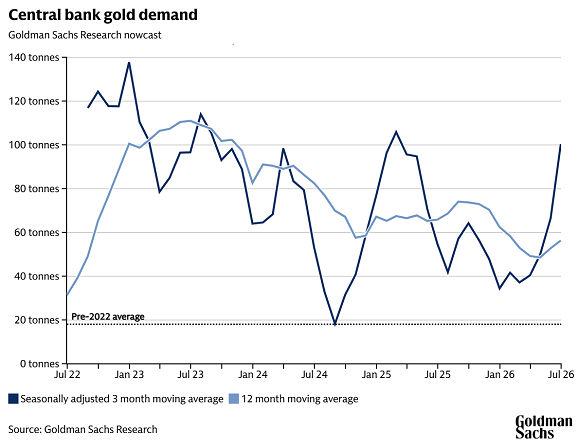
"Central banks have been diversifying their holdings using gold [because it] is considered less likely to be frozen than reserves held in foreign currencies," said a note late-last month from US investment bank Goldman Sachs, "buying at an increased rate since 2022, when G7 countries responded to the invasion of Ukraine by freezing Russian central bank assets in Europe."
"China's official buying accelerated in August," says a note from the mining industry's World Gold Council, calling last month's reported 20-tonne addition to People's Bank gold reserves its heaviest since October 2023.
Gold prices have risen more than 130% in US Dollar terms since then, but risen 105% in terms of Chinese Yuan.
Crunching trade data and other statistics to uncover 'hidden' gold reserves demand, Goldman Sachs' latest analysis puts China's 'true' central bank gold buying at 35 tonnes in total for July, when the PBoC officially reported near-20 tonnes growth.
"China's gold reserves represent only a small share of total [foreign exchange] reserves," says ICBC Standard, "leaving substantial scope for further buying."
Today saw private-sector gold prices in China fall in Yuan terms to the lowest since early August. But Shanghai's benchmark price flipped back to a premium compared to London quotes in Dollar terms worth over $11 per troy ounce, suggesting stronger demand in the precious metal's No.1 mining, consumer and central-bank gold buying nation.
Weak retail sales, house prices and fixed-asset investment data in the world's 2nd largest economy meantime saw China's CSI300 stock index fall to the lowest since April on Tuesday.
China's benchmark 10-year government bond price held firm, edging the yield offered to new buyers down to 1.68% per annum, close to New Year 2025's modern-era record low.
Comparable US Treasury yields in contrast touched 5.04% per annum on Tuesday, the highest since July 2007.
Ten-year UK Gilt yields also hit the highest since that month - eve of the global credit crunch which saw the US subprime mortgage crash morph into the Western banking and then global financial crisis - up at 5.44%.
Germany's 10-year Bund yield rose to 3.57%, its highest since 2009, and Japan's 10-year JGB yield rose to 3.04%, its highest since 1996.









 Email us