
$5000 Gold Halves 21% Crash as China Cuts US Bonds, Japan Votes for Stimulus
GOLD and SILVER prices rose back above $5000 and $80 per ounce respectively on Monday as the US Dollar weakened, Chinese regulators told banks to cut their US Treasury bond holdings, and Tokyo's stock market led global equities higher after a resounding election victory for the governing LDP party's economic stimulus plans, writes Atsuko Whitehouse at BullionVault.
With gold recovering exactly half of its 21.3% crash from end-January's new all-time gold highs near $5600 per Troy ounce, silver today regained a little more than 1/4 of its 47.2% crash from $121.
Monday's continued rally in precious metals came as the price of Japanese government bonds fell with US Treasury bonds after Japan's Sanae Takaichi − the world No.4 economy's first ever female prime minister − won a landslide victory, giving her governing Liberal Democratic Party a two-thirds supermajority in parliament's lower house.
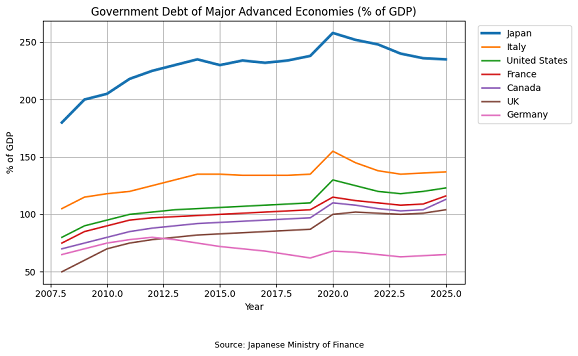
That took 10-year JGB yields up near late-January's 3-decade records above 2.35% per annum after Takaichi won on a promise to increase government spending and suspend consumption tax on food for 2 years despite Japan already carrying the heaviest sovereign debt burden in the developed world.
Japan's government debt reached over ¥1.1 trillion ($7.2 trn) at the end of 2025 according to Japan's Ministry of Finance, with the debt-to-GDP ratio exceeding 230%, almost twice the level of the USA.
Investors in Japanese government bonds suffered a $41 billion drop in value last month after Takaichi called the snap election on 20th January.
Ten-year US Treasuries also fell on Monday, pushing yields – a benchmark rate for government as well as many financial and commercial borrowing costs – up two basis points to 4.23% ahead of US jobs, inflation and retail sales data due this week.
Financial regulators in China have urged commercial banks to limit purchases of US government bonds, instructing those with high exposure to cut their positions, according to un-named sources quoted by Bloomberg.
But the move was framed around diversifying market risk rather than geopolitical manoeuvring or a fundamental loss of confidence in US creditworthiness, the news-wire says.
China's sovereign holdings of US Treasury debt fell to $682.6 billion in November, down around 1% month on month according to data released by the US Department of the Treasury last month.
The People's Bank of China (PBOC) grew its gold bullion reserves yet again in January, new data said this weekend, albeit by only 1 tonne to 2,308 tonnes.
"Fresh PBOC data confirmed a fifteenth consecutive month of gold reserve accumulation, reinforcing China's broader strategic diversification away from US Treasuries," says the trading desk of Chinese-owned London bullion bank ICBC Standard.
"Unruly" trading in China is what caused the recent wild swings in global gold prices, said US Treasury Secretary and former hedge fund manager Scott Bessent to Fox News yesterday.
With Chinese New Year set to shut the Shanghai Gold Exchange for a week starting Friday, gold prices in China – the No.1 mining producer, household consumer, central-bank buyer, and net importer – rose 3.5% today to a 3-session high of ¥1124 per gram, trading at the equivalent of a $12 per ounce premium to London quotes, indicating recovering demand.
The Shanghai gold premium climbed as high as $46 during last week's global gold price crash before turning to a discount on Friday's strong rally as the Shanghai Gold Exchange (SGE) and Shanghai Futures Exchange (SHFE) both announced hikes to margin requirements for new trading positions, aimed at cooling volatile trading.
Global stock markets meanwhile steadied on Monday as the pan-European Stoxx 600 edged higher by 0.2%, while S&P500 futures were little changed after the benchmark's best session since May on Friday followed sizable losses last week.
Tokyo's Nikkei 225 stock index rose 3.9% to a new all-time high following Takaichi's election win.
The Dollar Index – a measure of the US currency's value versus its major peers – fell 0.3% this morning, marking its second consecutive session of losses.
The greenback weakened more sharply against the Chinese Yuan, falling to a 33-month low.
Silver lease rates in London meantime eased to 3% annualized on 1-month deals, half the spike seen on Friday.










 Email us