
Gold Falls, Silver Tumbles on 'Long Squeeze' of Speculators in China
GOLD FELL and silver tumbled in heavy trading on Thursday, pulling the 'safe haven' metal down to a 1.1% loss for the week so far while its industrially-useful cousin sank 12.8% from last Friday's finish amid what Chinese media call "epic volatility".
Shanghai silver futures contracts had already lost more than 10% today, while the new platinum contracts on the Guangzhou Futures Exchange fell nearly 8% and Shanghai tin futures dropped over 7%.
New data from the China Gold Association today said that household gold demand in the world's No.1 gold consumer nation dropped to 950 tonnes across 2025, with jewellery purchases crashing 31.6% by weight but retail bar and coin sales jumping by 35.1%.
That put demand for those retail investment products at 1.4 times the demand for adornment items, extending a dramatic switch in Chinese households' gold buying which first became visible last spring.
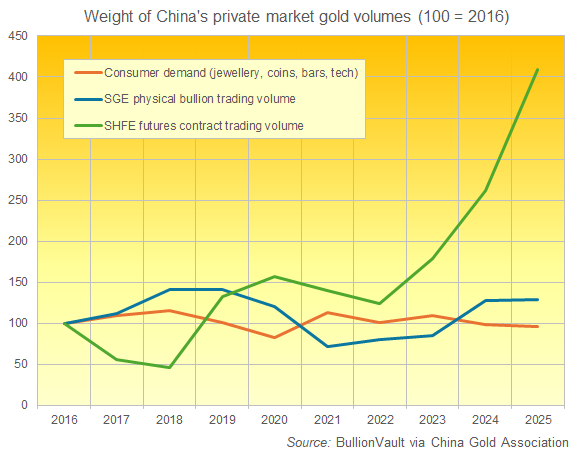
Over the past decade, the total annual weight of end-user gold demand in China has remained relatively constant according to BullionVault analysis of the CGA's data since 2016. So too has the weight of gold trading volumes on China's official physical bullion market, the Shanghai Gold Exchange.
But derivatives trading on the Shanghai Futures Exchange, in contrast, has exploded over the past 3 years, with the notional weight of gold traded through SHFE futures contracts jumping by 229.1% between 2022 and 2025 on the CGA's data.
Away from Shanghai's official derivatives exchange on Thursday, the gold trading scandal in China's 'shadow market' today deepened further as China Business Network reported that a state-owned enterprise was in a joint-venture partnership with gold and derivatives provider JWR.
JWR's offices have been stormed this week by thousands of angry speculators demanding the return of what could be as much as $1.4 billion in lost money, scenes repeated at competitor platform Ydd007's offices.
"Originally a gold raw material trader in the Shuibei area" of major manufacturing hub Shenzhen, says STCN, "JWR purchased and recycled gold raw materials from upstream suppliers and supplied them to downstream small merchants.
"But in recent years, JWR's business gradually shifted to precious metals retail and opened up gold pre-price trading to retail investors, thereby expanding its risk exposure."
"Forward contracts have been common among companies in the Shuibei district," says CNA, "as wholesalers seek to lock in prices, manage volatility and secure supply.
"But with gold and silver prices shooting through the roof over the past year, such arrangements have increasingly been extended to retail investors allowing short-term transactions that function much like futures with extremely low entry thresholds and no regulatory oversight."
Beijing's communist government has repeatedly attempted to clamp down on unauthorized precious metals speculation in recent years.
"Today's round of declines in silver prices," says Xia Yingying, head of precious metals and new energy research at Nanhua Futures, "was accompanied by a rebound in the US Dollar, a simultaneous weakening of Bitcoin and US stocks, coupled with the fourth consecutive limit-down of the Guotou Silver LOF Fund."
China's only pure-play silver tracking ETF today fell 'limit down' once more, losing 10% on the Shanghai stock market and locking shareholders out of selling or buying at a reference price now more than 1/3rd below last Thursday's record peak.
"In this highly volatile environment," says Xia, "that 'long squeeze' further exacerbated the decline in silver prices."
China's stock market also fell again on Thursday, dropping 2.5% from this time last month as Western equities fell for the 3rd session running on the MSCI World Index.
Gold in London bounced $50 per ounce off $4800, while London silver prices sank within 60 cents of Monday's 4-week lows beneath $72, down almost $50 per ounce from the record high set only last Thursday.
Leading up to last Thursday's record high $5600 gold price peak and crash on Friday, the final week of January 2026 saw Asian gold ETF holdings led by China swell by 39 tonnes, according to data compiled and published by the mining industry's World Gold Council.
That was almost 3 times the inflows to North American gold ETFs and greater than all but the strongest 4 of the past year's total global weekly inflows.
As a proportion of total global gold-backed ETFs, Asian-listed funds have now jumped from 6.8% to 12.0% over the 12 months.
Last week's China-led growth contrasted with net liquidation of more than 5 tonnes in European-listed ETF products.









 Email us