
Gold Resilient as $100+ Oil Surge Breaks Correlation on Trump’s Hormuz Threat
GOLD PRICES firmed even as oil surged above $100, with their usual correlation weakening after US President Donald Trump threatened to blockade the Strait of Hormuz following failed US-Iran peace talks, writes Atsuko Whitehouse at BullionVault.
Global benchmark Brent crude jumped almost 8% to $102.60 per barrel in early trading on Monday, after posting its steepest weekly loss since August 2022 last week on optimism that US–Iran peace talks could lead to a deal.
Spot gold fell as much as 2.2% to $4642 per ounce early Monday, before paring roughly four-fifths of the loss by London lunchtime, leaving prices about $20 below the previous close. This followed the yellow metal recording a second consecutive weekly gain, having recovered 16.5% from its low since the Middle East conflict - dubbed “Epic Fury” - began at the end of February.
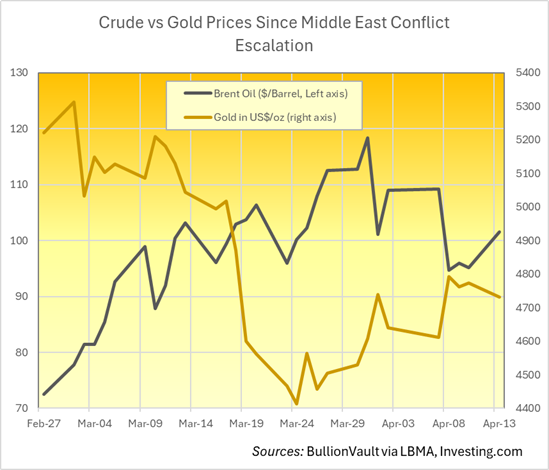
“The escalation by Trump threatens to see oil open or trade higher (and gold lower, given its 7-week inverse correlation with oil),” said Nicky Shiels, head of metals strategy at Swiss refining and finance group MKS Pamp.
High-frequency estimates suggest that the 20-day rolling correlation shifted from positive (with an r coefficient of 0.6 before the conflict) to negative (with an r coefficient of 0.5 by the end of March). However, the strength of the relationship has since weakened to 0.2.
Under normal circumstances, both oil and gold - being dollar-denominated assets - tend to move in the same direction (i.e., exhibit a positive correlation), supported by shared drivers such as the US dollar and inflation expectations.
During the Iranian conflict, however, this relationship diverged. Oil prices surged on supply concerns, while gold came under pressure as rising inflation lifted expectations of tighter monetary policy by the Federal Reserve, resulting in a negative correlation with oil.
“Gold seems to be developing some resilience on the downside,” said Bruce Ikemizu, Chief Director of the Japan Bullion Market Association, noting that the price recovered to $4700 easily on Monday.
“It feels like the market is getting used to this kind of movement and is now actually looking for buying opportunities in assets that have been liquidated into cash.”
The shift followed a sharp escalation in US-Iran tensions on Sunday, when US President Donald Trump said: “Effective immediately, the United States Navy, the finest in the world, will begin the process of BLOCKADING any and all ships trying to enter or leave the Strait of Hormuz.” The move came after the US and Iran failed to reach a deal following 21 hours of peace talks in Pakistan over the weekend.
While Trump described a full blockade of the Strait of Hormuz affecting all ships, US military officials later clarified that only vessels going to or from Iranian ports would be targeted, allowing other traffic to pass.
Iran condemned the move as an act of war, warning of a strong response and insisting it will not yield control of the Strait.
European natural gas futures jumped as much as 17% in early Monday trading.
Europe could face a jet fuel shortage within three weeks if disruptions in the Strait of Hormuz persist, according to Airports Council International Europe (ACI EUROPE), which has urged immediate EU intervention by writing to the EU’s energy and transport commissioners.
Jet fuel prices rose to $1573 a tonne last week, according to price-reporting agency Argus Media, up from $750 before the outbreak of the Iran conflict.
Market-based forecasts for where the US Federal Reserve will set its key interest rate at the end of this year edged up by 3 basis points to 3.6% on Monday from a 3-week low last Wednesday, according to data from derivatives exchange the CME.
In late March, implied rate expectations rose to nearly 4.0% as gold prices fell to a 12-week low of $4413, driven by growing concerns over a prolonged Middle East conflict.
Although headline PCE inflation released last Friday came in stronger than expected, while core inflation (which excludes food and energy and is the Federal Reserve’s preferred inflation measure) remained relatively steady, the data reinforced sticky underlying inflation without materially altering near-term rate expectations for the Federal Reserve.
Consumer confidence, meanwhile, plunged to a record low in April, with the University of Michigan’s headline index of consumer sentiment tumbling 10.7% from the previous month, according to data released last Friday.
European stocks fell, with the pan-European Stoxx 600 down 0.8% on Monday, as all major bourses declined and most sectors - oil and gas excepted - were in the red.
Gold prices in euros broke back below €4000 in early Monday trading, having set that level as a record high three months ago. UK prices similarly fell beneath £3500 per ounce, with prices in both currencies down as much as 1.8% from the previous close before recouping more than half their losses by London midday.
The Dollar Index - a measure of the US currency's value versus its major peers - edged higher by 0.3%, after the greenback fell to a six-week low in the previous session on hopes of progress in the US-Iran peace talks over the weekend.
Ten-year US Treasury yields - a benchmark rate for government as well as many finance and commercial borrowing costs - rose two basis points to a one-week high of 4.3%. Japan’s 10-year government bond yield, meanwhile, climbed to its highest level since 1997.
In European politics, Hungary’s Prime Minister Viktor Orbán conceded defeat in parliamentary elections on Sunday night after voters handed the opposition Tisza Party a landslide victory, ending 16 years of his dominance. Long seen as maintaining close ties with Vladimir Putin and sharing ideological affinity with Donald Trump, Orbán has also been a persistent critic of the European Union, making the result a potentially significant shift in Hungary’s position within Europe.
Hungary has significantly increased its gold reserves over the past few years, rising from around 3 tonnes in 2016 to about 110 tonnes today as part of a strategy to strengthen financial stability.









 Email us