
Gold Falls Through $5000 Even as War Spikes Stagflation Fears
GOLD PRICES fell below $5000 per Troy ounce on Monday, nearing 4-week lows, despite heightened stagflation fears as European crude oil rose above $100 per barrel following US and Iranian attacks targeting energy infrastructure in the new Middle East war, writes Atsuko Whitehouse at BullionVault.
Spot gold briefly fell to $4969.34 in early trading on Monday, before paring the loss by London lunchtime. The drop through $5000 gold came after the yellow metal recorded its second weekly loss in a row since the US-Israeli attacks on Iran began.
"The US economy now faces its second stagflation-like shock inside a year," says Sal Guatieri, senior economist at Canadian bank BMO Capital Markets, referring to last spring’s Trump trade tariffs shock.
“As long as uncertainty about the outlook persists, there is a risk that the move toward ‘cash conversion’ will continue, leading to selling across all risk assets (including gold),” says Bruce Ikemizu, chief director of the Japan Bullion Market Association.
“The more the war escalates, the greater the risk that the economic and financial implications will go well beyond a surge in energy prices and higher borrowing costs to include broader inflationary pressures, lower growth, higher unemployment, and a greater risk of systemic financial instability,” says economics professor and advisor to German insurance giant Allianz, Mohamed El-Erian.
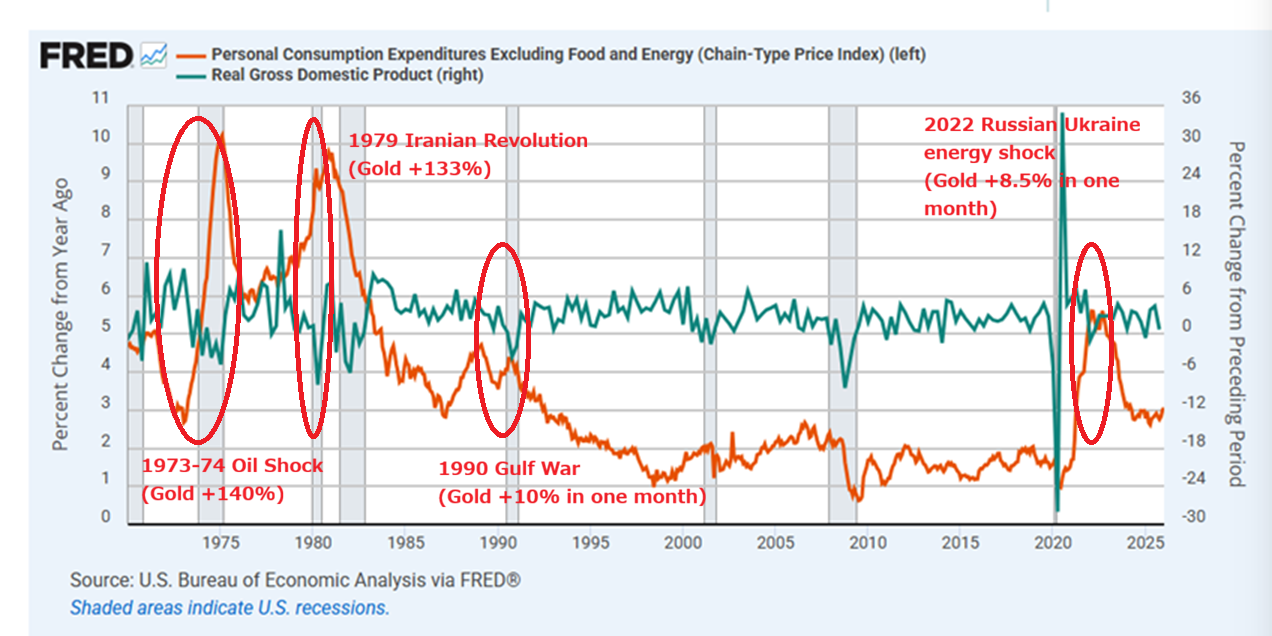
Latest data published on Friday shows that the Federal Reserve’s preferred inflation gauge – the core US Personal Consumption Expenditures Price Index (PCE) – was running at 3.1% year-on-year in January, before crude oil prices rose above $100 following the US-Israel attack on Iran at the end of February.
Core PCE inflation has now exceeded the Fed’s 2% target for six years.
Meanwhile, US Gross Domestic Product grew by only 0.7% in the fourth quarter of 2025, half the previously estimated rate, even before the Middle East conflict began.
“If oil prices temporarily rise to $100 per barrel, we estimate that global headline inflation could rise by 0.7 percentage points and global growth could slow by 0.4 percentage points,” warned Goldman Sachs soon after the US-Israel attack on Iran.
Gold has historically performed strongly during major oil-related crises, particularly when energy shocks triggered stagflation, the combination of high inflation and weak economic growth.
During the 1973-1974 Oil Shock, oil prices surged as Arab producers cut supplies, pushing Western economies into stagflation. As inflation accelerated and economic activity slowed, investors increasingly turned to gold as a store of value. Gold prices rose sharply, climbing roughly 140% between 1973 and 1974.
A similar pattern emerged during the Iranian Revolution, which triggered the second major oil shock. Disruptions to Iranian oil production drove crude prices higher and intensified global stagflation pressures.
In response, gold surged from $226 at the start of 1979 to $524 by year-end, later reaching record highs in early 1980 as investors sought protection against rising inflation and geopolitical uncertainty.
During the Gulf War in 1990, oil prices briefly doubled amid fears of supply disruption in the Middle East, and gold rose about 10% within roughly a month, reflecting safe-haven demand but without the sustained stagflation seen in the 1970s.
More recently, the Russian invasion of Ukraine triggered a global energy shock as sanctions on Russia disrupted oil and gas markets. Gold climbed 8.5%, touching $2,039 per ounce in March 2022, close to its all-time high, as investors sought protection against rising inflation and geopolitical risk.
"On the heels of the trade war, the Iran war will lift inflation and bond yields, disrupt energy supply chains, rattle investor and business confidence, and weaken global demand," continues Guatieri at BMO.
Prices for silver, primarily an industrial metal, also fell Monday to near a one-month low beneath $78 per troy ounce before recovering to $81.42 by lunchtime in London.
Crude oil rose meanwhile to $100 per barrel after the US struck Iran’s Kharg Island oil export hub this weekend, prompting Iranian threats against regional energy infrastructure and heightening risks to global oil supply as US President Trump demanded that America’s NATO allies join him in trying to keep the vital Strait of Hormuz open to tanker traffic.
Several major central banks, including the Federal Reserve, the European Central Bank, the Bank of England, and the Bank of Japan, are scheduled to hold policy meetings this week and are widely expected to keep interest rates unchanged, with markets closely watching the Federal Reserve’s updated quarterly dot-plot projections for clues about the future path of US interest rates.









 Email us