
Gold and Silver Slip as Bond Yields Hit Multi-Decade Highs
GOLD and SILVER PRICES slipped back Tuesday as global stock markets fell further from last week's fresh records in the face of new multi-decade highs in long-term interest rates in the government debt market.
"Global bond sell-off deepens," says the front page of the Financial Times' website.
"Governments pay the price [in borrowing costs] for US-Iran stalemate," says CNBC, attributing the rise in long-term rates to inflation.
"Three factors are at play," counters Anshul Pradhan, head of US rates research at investment bank Barclays Capital, pointing instead to "the [US] budget deficit outlook, AI-related corporate issuance [diverting money that would otherwise go into government bonds], and the changing Treasury buyer base" as foreign investors cut their holdings of Washington's debt.
"This is not just a US story," says precious metals strategist Nicky Shiels at Swiss bullion refiners and finance group MKS Pamp, with "the same bond-market fragility" hitting UK debt prices in particular.
"Rates pressure could be gold's headwind but it depends on duration. The long-end higher-for-longer call [contrasts with] softer hike odds in the front...[making it] not a clean directional call" for precious metals.
The price of gold today fell back beneath $4400 per troy ounce, down 1.0% from an overnight high but 9.6% higher from this time last month.
Silver bullion prices also erased most of yesterday's rise, falling back through $65 to drop 2.5% from an overnight test of last Wednesday's 7-week high but holding $10 per ounce above mid-July's 7-month low.
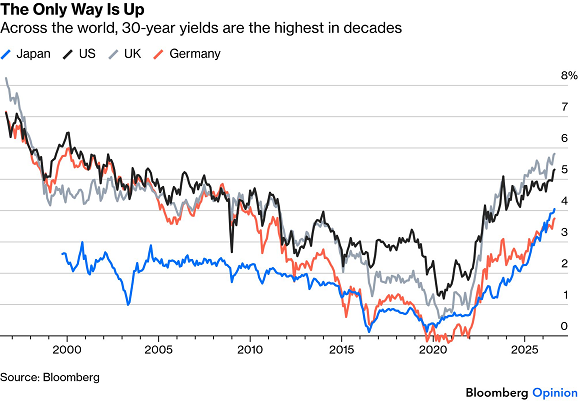
The US Dollar held steady on the currency market, and 30-year US Treasury bond yields held at 5.31% per annum, the highest since June 2007, eve of the subprime US mortgage crash morphing into a global credit crunch and then financial crisis.
But betting on the Federal Reserve's key overnight interest rate rose to put the odds of 'no change' at its next meeting at 2-in-3, with October now a 50-50 chance having been just a 1-in-8 shot in late-July according to the CME derivatives exchange's FedWatch tool.
Falling debt prices today saw the yield offered by Japan's benchmark 10-year bond hit yet another 3-decade high near 3% per annum.
But yields on comparable government debt in China dropped to 1.65%, the lowest since July last year, resuming the plunge starting in 2023.
New data Monday put Japan's economic growth at only 1.1% annualized in April-to-June − just ahead of the Eurozone but behind the UK and USA − thanks to a 2.6% jump in the GDP Price Deflator, a measure of economy-wide cost inflation.
China's GDP grew 4.3% per year in Q2, but that was near the weakest for the world's 2nd largest economy since modern records began outside of the 2020-2022 Covid pandemic.
July then saw fresh falls in China's fixed-asset investment and house prices, plus a further slowdown in the pace of industrial output and retail sales growth.
Brent crude meantime rose Tuesday to 3-week highs further above $90 per barrel after US President Trump tweeted a map of the Hormuz Strait titled 'New US territory' and threatened to "bomb" US ally Oman if it "gets in the way" of a peace deal with Iran over the key waterway it also borders.
Trump also said he's slashing US troop numbers in joint military exercises with South Korea, saying they "send a signal that is totally inappropriate and hostile" to the nuclear-armed hereditary dictatorship in North Korea.
Russia meanwhile threatened "consequences" for the UK after confirmation that Ukraine has used UK-made equipment in its drone attacks on military, energy and logistics infrastructure deep into its eastern invader's sovereign territory.









 Email us