
Gold and Silver Rally as Oil Retreats Despite Persistent High Bond Yields
GOLD and SILVER PRICES surged on Monday as crude oil fell, following a pause in US-Iranian strikes over the weekend. Benchmark US 10-year Treasury yields also eased from their highest level since 2023, although they remained near multi-year highs, writes Atsuko Whitehouse at BullionVault.
Spot gold rose as much as 1.6% to $4115 per ounce in early Monday trading, before giving back around a half of that gain by lunchtime in London. The move followed a 1.8% weekly gain, marking gold’s sixth weekly advance since the Iran war began, despite recent surges in oil prices and interest rates.
Silver prices also climbed, rising as much as 3.3% to $60.07 per ounce before giving back one-third of that gain by lunchtime in London. That also followed a 5.5% gain last week, marking silver’s seventh weekly increase since the start of the Iran war.
Crude oil prices dropped on Monday, with Brent oil futures falling more than 6% to below $90 per barrel. The US refrained from striking Iran for a second night, following 13 consecutive days of attacks, to allow more time for diplomatic efforts. Iran's army also said on Sunday that Tehran had suspended its military response.
Brent crude surged above $101 per barrel briefly last Thursday as attacks on Saudi oil tankers in the Red Sea raised concerns that supply disruptions could spread beyond the Strait of Hormuz to a second major shipping chokepoint.
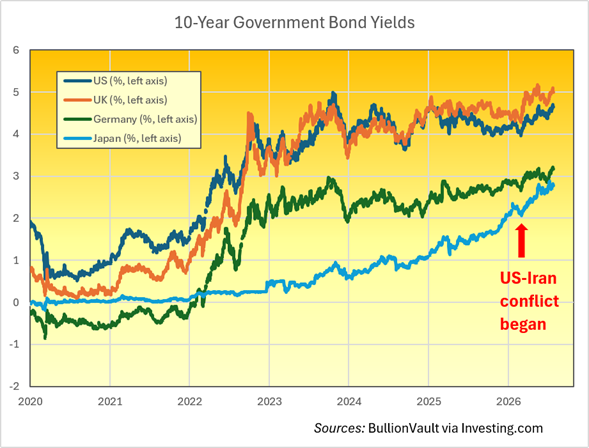
Ten-year US Treasury yields — a benchmark for government borrowing costs as well as many financial and commercial lending rates — fell 4 basis points to 4.6% on Monday, after rising to nearly a three-year high of above 4.7% last week.
The US 10-year Treasury yield has risen 17.0% since the Iran conflict began, despite the Federal Reserve leaving its policy rate unchanged during the period.
"There is a message here for the Fed," said Paul Christopher, head of global investment strategy at the Wells Fargo Investment Institute.
"Uncertainties are piling up, and the bond market expects to get compensated for it," he noted.
Both UK and German 10-year bond yields eased on Monday, falling 12 and 4 basis points, respectively, from levels reached last Thursday, when they touched a two-month high of 5.1% in the UK and a 15-year high of 3.2% in Germany. Even so, both yields remained sharply elevated since the Iran war began, up 15.8% and 19.6%, respectively. Japan's 10-year bond yield was little changed on Monday at around 2.8%, not far from the 30-year high it reached earlier this month, and remained up 31.1% since the US struck Iran at the end of February.
"The key question is whether governments can sustain these higher financing costs," said Bruce Ikemizu, chief director of the Japan Bullion Market Association, in his note last Friday.
"This is becoming a major concern," Ikemizu added.
"It would not be surprising if, at some point, one or more countries were to face a fiscal crisis as a result of mounting budget deficits," he concluded in his note.
Fitch Ratings warned last week that developed-market public finances are facing mounting pressure from both geopolitical shocks and long-term structural trends.
The agency said the ongoing flare-up in fighting between the US and Iran "highlight[s] lingering fiscal risks, through weaker GDP growth, higher interest costs and, in some cases, moderate energy subsidies," while forecasting that developed-market government debt will rise to US$75.8 trillion (104% of GDP) by the end of 2026.
The warning came just days after US Defense Secretary Pete Hegseth estimated that the conflict with Iran has already cost the United States US$37.5 billion, illustrating how geopolitical tensions can quickly add to fiscal pressures.
"The staggering rate at which the US is accumulating debt—about $7 billion per day—is atrophying the nation's ability to respond to a recession," warned Torsten Slok, Chief Economist at Apollo Global Management, an investment firm managing more than US$800 billion in assets.
This week's focus will be on central bank policy decisions, with announcements from the Federal Reserve on Wednesday, the Bank of England on Thursday, and the Bank of Japan on Friday.
The odds of a Federal Reserve rate hike this week have risen to around one in three, according to interest-rate futures, a sharp reversal from expectations for a rate cut immediately before the US-Iran conflict began.
The Bank of England is expected to keep its policy rate unchanged at 3.75% on Thursday, while the Bank of Japan is also forecast to leave its policy rate unchanged at 1.0% on Friday while signalling that further tightening remains likely.
The price in UK pounds, meanwhile, rose 0.5% to £3067 per ounce on Monday, while euro gold gained 0.6% to €3586. Gold for Japanese investors also rose 0.7% to ¥21,490 per gram, leaving bullion below January's record highs but still at levels that were themselves all-time highs for UK and euro investors last November and for Japanese investors last December.









 Email us