
Gold Heads for Best Week Since March 2020 After Weak US Jobs Data
GOLD PRICES surged on Friday after unexpectedly weak US jobs data, leaving bullion with its strongest weekly gain since March 2020, when investors sought safe-haven assets at the height of the Covid-19 crisis. China's central bank, meanwhile, reported its largest monthly increase in gold reserves in nearly three years, while developments in the Strait of Hormuz kept geopolitical risks in focus, writes Atsuko Whitehouse at BullionVault.
US non-farm payrolls unexpectedly fell by 23,000 in July, well below forecasts for an 80,000 increase, while payroll gains for May and June were revised down by a combined 103,000. The unemployment rate, however, fell to 4.1% from 4.2%, while annual wage growth eased to 3.2% from 3.4% in June.
Spot gold jumped more than $100 per ounce to $4368 immediately after the data was released, after already gaining more than 1% earlier in the day, as investors looked past escalating tensions in the Middle East. The yellow metal was on track for an 8% weekly gain at London's afternoon benchmark auction, the biggest increase since March 2020, when the Covid-19 pandemic triggered extreme volatility across global financial markets and a surge in demand for safe-haven assets.
US monthly payroll growth has slowed dramatically from the exceptionally strong hiring seen in 2021–22. Although the labour market remains resilient, job creation has moderated steadily, with average monthly payroll gains falling from 491,000 in 2021–22 to 166,000 in 2023–24, before slowing further to just under 29,000 since the start of 2025. During the past 19 months, payroll growth has remained below 100,000 in 14 months, including six months of outright job losses.
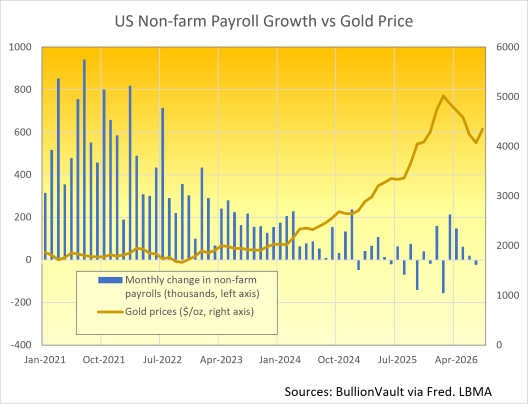
"There's no overheating here," said Claudia Sahm, Chief Economist at New Century Advisors, after July's payroll report unexpectedly showed a loss of 23,000 jobs and sharp downward revisions to the previous two months.
Betting on the next Fed decision in September now sees a 3-in-5 chance that the US central bank will hold its policy rate at 3.50 – 3.75% per annum, increasing from 1-in-3 a week ago, according to the FedWatch tool from derivatives exchange the CME.
The weaker-than-expected payrolls data also sent the US dollar and Treasury yields sharply lower. The Dollar Index fell around 0.5% to a two-month low, while the benchmark 10-year Treasury yield slipped to around 4.61%, also its lowest level in two months. The policy-sensitive 2-year Treasury yield dropped to around 4.15%, near a three-week low.
This week's US labour market data also showed signs of softer hiring ahead of Friday's Non-Farm Payrolls report. The JOLTS survey showed job openings declined to 7.36 million in June from 7.54 million previously (revised), below the consensus forecast of 7.44 million. The ADP National Employment Report showed private-sector employment increased by 44,000 in July, well below the consensus forecast of 75,000 and down from a revised 95,000 increase in June, while annual pay growth for job stayers remained at 4.4%.
The Federal Reserve delivered a hawkish hold at its July FOMC meeting, leaving its policy rate unchanged while stating that "job gains have kept pace with the workforce, and the unemployment rate has changed little." The decision was not unanimous, however, with three FOMC members dissenting in favour of an immediate rate hike, underscoring the Committee's continued effort to balance its dual mandate of maximum employment and price stability.
"We maintain a constructive longer-term view that could see gold retest or approach the $5,000 level," said Suki Cooper, Global Head of Commodities Research at Standard Chartered, a London bullion market-maker, in a recent interview, citing continued central bank buying, resilient ETF demand, geopolitical uncertainty and diversification away from the US dollar as key long-term drivers.
Data published today shows that the Chinese central bank increased its gold reserves by 20 tonnes in July – the largest monthly increase since October 2023. It marks the 21st consecutive month of additions. That lifts its year-to-date increase to just over 60 tonnes, and total gold holdings to 2,366 tonnes.
It was reported this week that the Bank of Korea, meanwhile, has resumed buying gold for the first time in 13 years by investing in spot gold ETFs and preparing to purchase domestically produced bullion, reflecting a strategic shift to gradually increase gold's share in its foreign exchange reserves amid heightened geopolitical risks and growing demand for safe-haven assets.
Global gold-backed ETF holdings rose by 23 tonnes in July, marking a return to net inflows after two consecutive months of outflows, while Asian-listed funds remained the largest contributor to year-to-date inflows, according to the latest report from the World Gold Council.
Prices for silver, which derives nearly 60% of its annual demand from industrial uses, also climbed more than 5% to $65.04 per ounce on Friday after the weaker-than-expected US jobs data. The grey metal posted a weekly gain of nearly 11% at London's benchmark auction before the jobs report, the strongest increase since the end of February before the US-Iran conflict began.
Platinum and palladium prices also climbed by 8% this week, marking their strongest weekly gains since the week ending 10 April for platinum and 23 January for palladium.
Oil prices edged lower by Friday lunchtime, with Brent crude falling 0.3% to just above $82 a barrel after Thursday's 3.8% gain. Crude initially rose on reports that Iran planned to bar US and Israeli ships from the Strait of Hormuz and charge hostile countries for transit, while Yemen's Houthi militants claimed a large-scale attack on Saudi-backed forces.
Prices later turned lower as investors weighed reports of progress towards a temporary agreement to reopen the strategic waterway, while the weak US jobs report also dampened the outlook for oil demand.









 Email us