
US Gold ETFs Below 50% Market Share as Asia Expands on Falling Price
The PRICE of GOLD fell Tuesday as the US bond market returned from the Columbus Day weekend, extending the precious metal's longest drop in a decade as data pointed to weak speculative and ETF investment demand for gold from traders in the world's largest economy.
CORRECTION: The original version of this story said that last Friday's data put the USA's share of global gold ETFs at the lowest since the launch of the giant GLD trust fund.
In fact, and as measured by the number of tonnes needed to back the shares in issue, the North American share of the gold ETF market worldwide was lower in Nov + Dec 2022, the onset of Covid in March 2020, repeatedly through spring + summer 2019, and periodically in fall + winter 2018. It bottomed beneath 48.1% in early June 2019.
Sorry for the error. Now at 49.6%, US dominance hasn't been as low as last Friday in almost 200 weeks, and never with Asia's share this high, now at 12.8% of the global total.
With the gold price in US Dollars now dropping for 6 weeks in a row, speculative betting that gold prices will rise has also shrunk for 6 weeks running in Comex futures and options, data from US regulator the CFTC says.
Worldwide, in contrast, exchange-traded trust funds backed by gold have expanded, needing an additional 80 tonnes of bullion and defying the gold ETF sector's more typical correlation with prices.
But US-listed gold ETFs have accounted for just 38.1% of that growth, seeing net outflows in 3 of the past 6 weeks and now accounting for a 49.6% share of the global gold ETF sector's total holdings, according to data compiled and published by the mining industry's World Gold Council.
That figure has fallen from 51.9% at the start of this year and marks the lowest share for US ETFs in the sector's global market since December 2022.
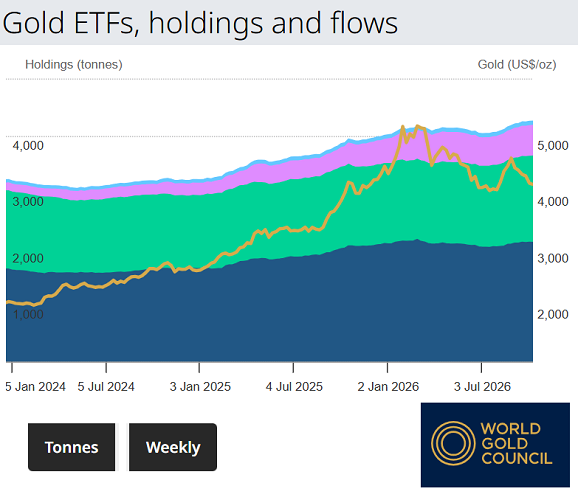
Over the 12 months to end-September, the WGC data show, US-listed ETFs accounted for 29.8% of the 402-tonne net growth in global gold ETFs, beating Europe's 20.4% share but dramatically behind Asia at 48.5%.
The reason gold isn't trading back at $5000 or even $10,000 is because US institutional investors still aren't involved, said Swiss bullion refining and finance group MKS Pamp's strategist Nicky Shiels last week, chairing the Investment Panel discussion at the LBMA/LPPM trade associations' annual conference.
The catalyst for them buying gold, replied investment manager Shayne McGuire, will be the bond market, because the sheer scale of new supply to the debt market simply won't let yields come down.
"Last year was odd," McGuire told the precious metals market conference, because the jump in gold prices didn't alert institutional investors that there's big trouble coming in bonds.
"I think it will happen in time."
As bullion has fallen by 8.5% since the end of August's steep gold price rally, the net bullish position of hedge funds and other Managed Money traders in US gold futures and options has shrunk by almost one quarter.
That's the steepest 6-week decline in Comex gold's net spec position in futures and options contracts since the precious metal's record-high price this January was followed first by the highest volatility since Lehman Brothers' collapsed in 2008 and then the start of the US-Israeli war on Iran at the beginning of March.
Equal to a notional position of 357 tonnes as of last Tuesday, the CFTC's reporting date, the net long Comex gold futures and options position of Managed Money speculators was also 1/5th smaller than its 5-year average.
With its primary listing in New York meanwhile, the giant SPDR Gold Trust (NYSEArca: GLD) closed Monday needing one-fifth less gold backing than the record set as the US Fed's QE 'money printing' campaign peaked at the end of 2012, while world No.2 gold ETF the iShares product (NYSEArca: IAU) is currently 1/8th smaller than its peak of November 2020, when gold fell hard from its Covid pandemic peak on news of Pfizer's successful vaccine trials.










 Email us