
Iran War Sees Gold ETFs Shrink with Comex Trading as Fed Rate Forecasts Jump
GOLD and SILVER struggled against a falling US Dollar on Tuesday, dropping through $5000 and $80 per Troy ounce after bullion-backed ETFs shrank again while Comex trading volumes continued to quieten amid the war on Iran.
Brent crude rose back above $100 per barrel as Iran continued to attack neighbouring oil-producer nations.
But the USA said it is allowing Iranian oil tankers bound for China to transit the Strait of Hormuz − closed to other traffic by Tehran − "to supply the rest of the world".
Israel said it has assassinated Tehran's security chief and also intensified its attacks on southern Lebanon, where 1-in-5 civilians is now displaced.
"In an environment like this, one would imagine gold should be rising," says a note from London-based $225 billion asset managers Man Group, but "moments of market stress typically see profitable positions being unwound first."
Trading volumes in gold and silver Comex derivatives have sunk since the Iran war began a little over a fortnight ago, while bullion-backed ETF trust funds have shrunk almost without pause.
"Elevated oil prices are helping to heighten inflationary fears, prompting suggestions that the FOMC may be slightly more hawkish," says analyst Rhona O'Connell at StoneX, noting that US consumer spending data was already weak for January, "before the war started."
With the Fed's monetary policy committee set to hold interest rates unchanged tomorrow while issuing new 2026 inflation forecasts, trading in the futures market now sees the US central bank ending this year close to the Fed's own most recent projection of 3.40% per annum, requiring only one cut of 25 basis points between now and Christmas with a dramatically higher year-end rate than the market predicted prior to the war.
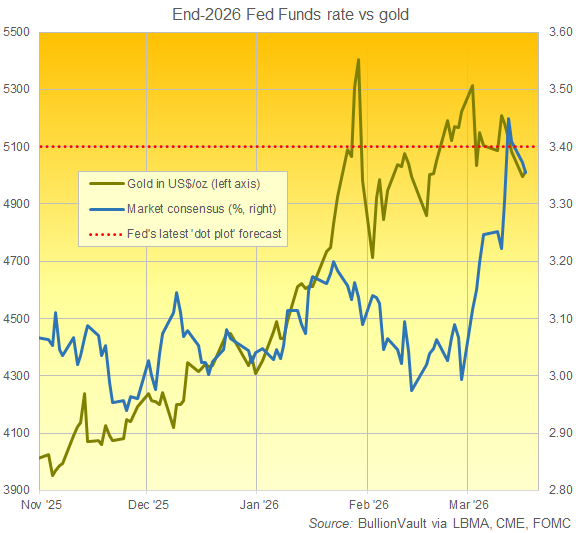
"A fast, flow-driven correction [in the gold price] remains possible if positioning unwinds," says a note from French bank Société Générale.
"[But] geopolitical stress − continued Russia-Ukraine uncertainty, persistent Middle East flashpoints, and fragile Red Sea/Suez security − keeps the upside tails very much alive."
Amid such market uncertainty, "gold has been effectively marking time over much of February and March," says O'Connell at StoneX, and "silver has been taking a similar path, finding support just below $80."
Silver spiked over $5 per Troy ounce early Tuesday from yesterday's near-4 week low, peaking at $82.55 before dropping $3 to trade more than 15.7% below its pre-war level.
Peaking at $5030 per Troy ounce meantime, gold fell over $50 in late-London trade before rallying back towards the $5000 mark, losing over 5.3% for the month of March so far.
Since the war began, trading volume in Comex gold futures contracts has dropped by 25% from 2026's pre-war average, and it has sunk by almost 40% in more leveraged CME gold options.
Silver futures and options volume combined has meanwhile sunk by 60% compared with the first 2 months of the year.
Giant gold-backed ETF the SPDR Gold Trust (NYSEArca: GLD) yesterday shrank to its smallest size in almost 9 weeks, needing 2.8% less bullion at 1,071 tonnes than it did on Friday 27 February, eve of the USA-and-Israel attacks on Iran.
World No.2 gold ETF the New York-listed IAU from iShares also shrank again, reaching its smallest size since early December at 486 tonnes after seeing a net inflow only once since the war began more than 2 weeks ago.
The giant SLV silver-backed ETF meantime shrank on Monday to need 104 tonnes less bullion backing, taking it down to the smallest in nearly 4 months at 15,356 tonnes.
Silver priced in Euros today fell below €70 per Troy ounce while the UK Pound price held just above £60, also a new all-time high when first reached amid late-December's chaotic Chinese Christmas bullion trading.
Gold outside the Dollar meantime struggled around 3-week lows at €4340 and £3750, both a new all-time high when hit in late-January's record precious metals price spike.
Betting on Fed Funds interest rates meantime shifted back towards the US central bank starting to cut the overnight cost of borrowing in September.
Prior to the war starting 17 days ago, the futures market had put a 57% likelihood on the Fed starting to cut rates in June, an outcome now seen as just a 23% shot.









 Email us