
Oil 'Keeps Strangling Gold' as World Energy Crisis Worsens
GOLD PRICES in London reversed half of yesterday's 3% rebound on Friday, heading for the lowest week-end close since late-March as crude oil held strong despite rumours that Iran is engaging with a US peace plan via Pakistan.
After steadying in April to recover just $3 per Troy ounce of March's $600 Iran War crash, the price of gold in London today continued to mirror the action in crude oil contracts and falling back to $4600.
That was a new record high when reached in mid-January on the way to that month's record gold spot-market peak $1000 higher again.
"Oil is strangling gold," said one London trader to BullionVault today as the price of crude traded $10 below yesterday's fresh 4-year high.
"Upside momentum in gold remains constrained," agrees a trading note from Chinese bank and London bullion clearers ICBC.
"Over the past two weeks alone, crude prices have surged by more than 25%."
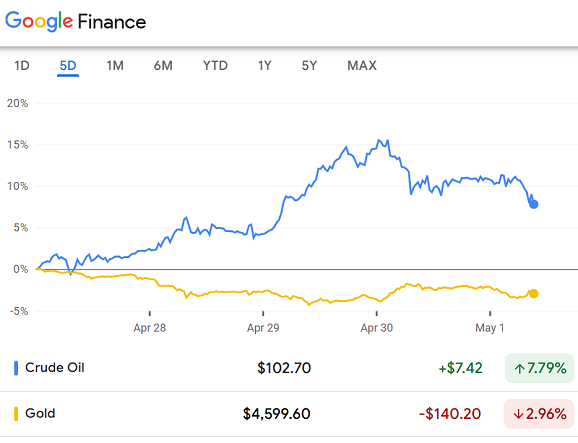
With the vital Strait of Hormuz now blockaded by both Iran and the US Navy, "The world is facing the biggest energy crisis in history," said International Energy Agency head Fatih Birol on Thursday.
"The oil price is putting a lot of pressure on many countries."
World No.2 gold consumer and No.8 central-bank gold holder India "relies on imports for 90% of its oil," says financial news-site Mint, estimating that every $1 added to a barrel of crude adds around $1.7 billion to the subcontinent's annual energy import bill, which totalled $122bn over the past 12 months.
With global jewellery demand already crashing in 2026 in the face of record-high gold prices, imports of the precious metal to India sank last month to the weakest in 3 decades according to un-named sources quoted by the Reuters news agency, as the BJP Government of Narendra Modi imposed an additional 3% levy for 'integrated goods and services tax', effectively reversing 1/3rd of 2024's surprise duty cut.
No.1 gold consumer and No.5 central-bank holder China − the world's heaviest importer of crude oil, relying on foreign supplies for 70% of demand − already 'rationalized' VAT sales tax on private gold trading last November, abolishing an offset for non-investment products.
"Gold's role as a traditional safe haven asset remains intact," says ICBC, "with central banks continuing to add to their holdings in the first quarter.
"The current price pullback may be viewed as a buying opportunity on dips...[because] the outlook remains bullish, especially if rising oil prices lead to [wider economic] demand destruction and heighten global recession risks."
"At some point, the market's focus will turn to growth risks and rate cuts again," agrees Chi Lo, senior market strategist for Asia Pacific at French bank BNP Paribas' asset management division.
"The gold price will then rebound. Central bank purchase will remain a long-term support for gold."









 Email us