
Gold Falls Hardest Since 2013 Crash as Iran War's Inflation Shock Sends Borrowing Costs Soaring
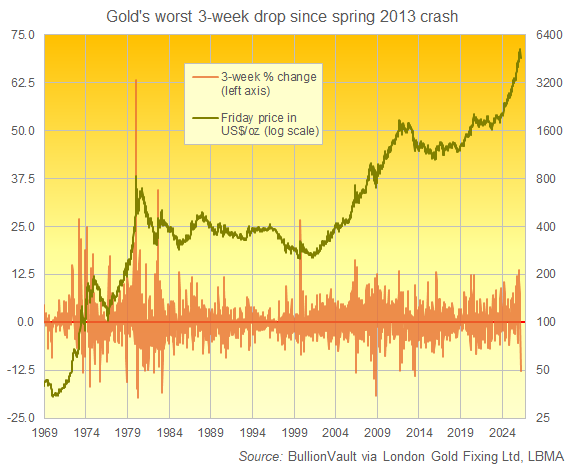
GOLD BULLION sank again on Friday, heading for the worst weekly drop since spring 2013's gold price crash as the Iran War's oil-price shock drove financial traders to start betting that central banks will now start to hike interest rates in a bid to curb energy-led inflation.
With crude oil trading near $100 per barrel as Iran reportedly charges $2 million per tanker to transit the Strait of Hormuz and Qatar says it will take 5 years to repair its Ras Laffan LNG gas capacity, global stock markets also fell again alongside industrial metals.
Bond prices fell further, driving benchmark 10-year US Treasury yields up to the highest borrowing cost since July last year, while Germany's Bund yields spiked to the highest since 2011 and UK Gilt yields hit 2008 levels.
Silver prices showed a 12.2% weekly drop at $73.45 per Troy ounce at London's midday auction, before losing another $3 in late trade.
Gold meanwhile sank to lose 9.5% in US Dollar terms from last Friday's 3pm benchmarking, trading around $4560 per ounce with its ugliest weekly drop in almost 13 years.
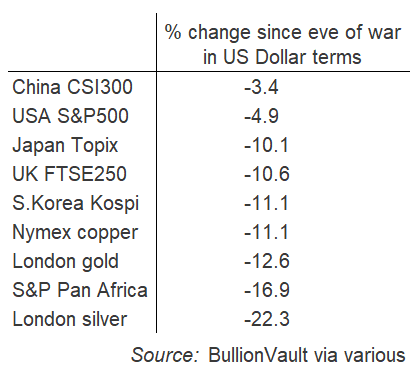
That put gold 12.6% lower from the eve of the US-Israeli attacks on Iran 3 weeks ago, also its sharpest such plunge since the gold price crash of June 2013, when the 'safe haven' precious metal finally find its floor from that spring's historic slump.
"The world is facing the greatest global energy security threat in history," says International Energy Agency chief Fatih Birol, urging national governments to cut driving speed limits and encourage people to work from home.
"[This shock] is much bigger than what we had in the 1970s [and] bigger than the natural gas price shock we experienced after the Russia's invasion of Ukraine."
With central banks worldwide holding rates unchanged this week after everyone expected a new round of cuts, Fed Funds futures traders now put a 1-in-3 chance on the US central bank raising overnight borrowing costs by the end of this year.
That was given a zero per cent chance until yesterday, according to the CME derivatives exchange's FedWatch tool.
The real yield offered over and above inflation by 10-year US Treasury TIPS bonds meanwhile leapt to 1.98% per annum today, rising by one whole Fed rate rise from the eve of the war.
Plunging by 6.7% today, copper futures on the CME's Nymex exchange headed for their worst week since the Trump administration reversed its import trade tariffs on the vital base metal last July.
Bullion-backed ETFs continued to shrink, with the giant GLD and IAU gold ETFs heading for their 3rd and 6th weekly outflows respectively, while the SLV silver ETF also fell for the 3rd week since the Iran War began.









 Email us