
Gold Slides, Oil Leaps as US-Iran War Dents AI-Fuelled Stock Market Records
GOLD PRICES slid on Monday, losing $135 per ounce from Friday's 2-week high as crude oil leapt and global stock markets retreated from new AI-led record highs on the US and Iran testing their Middle East ceasefire to the limit despite continuing talks about reopening the Strait of Hormuz, writes Atsuko Whitehouse at BullionVault.
With the price of gold dropping as low as $4460 per troy ounce, crude oil prices rose for the first time in four sessions, leaping 5.3% per barrel of Brent as the US carried out what Washington called "self-defence" strikes on Iranian radar and drone-control facilities, while Iran struck a Middle East airbase used by the US as well as sites across Kuwait.
Asian equity markets rose, with both the Kospi Index in Seoul and the Nikkei in Tokyo setting new all-time highs on fresh AI chip and tech news. But European bourses fell almost 1.0% after rising back towards end-February's record peak on the EuroStoxx 600 index.
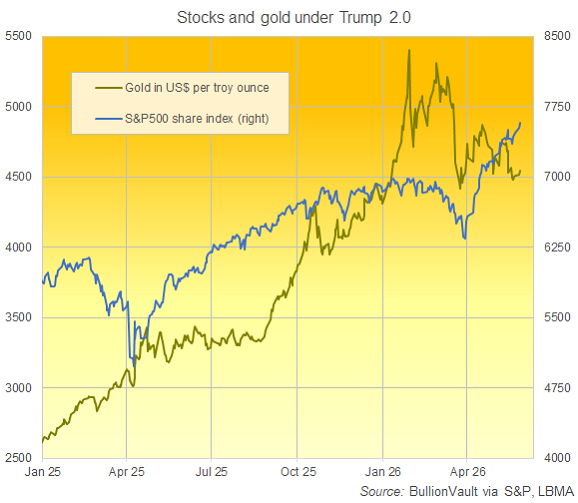
Friday saw Wall Street's increasingly tech-heavy S&P500 record its 9th weekly advance in a row, setting its 19th new record high of 2026 so far.
Gold, in contrast, has now fallen by almost 1/5th from end-January's all-time gold price peak.
"We remain positive on the outlook for gold and continue to view the precious metal as a source of diversification within portfolios," says Swiss banking giant and London bullion clearing member UBS.
Despite cutting its year-end gold price forecast from $5900 to $5500 per ounce, "Commodities offer a valuable hedge against inflation and supply shocks," UBS goes on, "and their typically low correlation with equities and bonds makes them an effective portfolio diversifier, especially in periods of market stress."
/infographics/ai-gold-precious-metal-price-forecasts
BullionVault analysis of daily data since 1969 finds that, long term, the 1-month correlation between gold prices and the S&P500 has been effectively neutral, averaging just +0.02.
That figure would read +1.00 if gold and the S&P always moved in lockstep together, or minus 1.00 if they always moved perfectly inverse.
The correlation coefficient eased back below +0.01 last month after running positive from December through April.
"By the end of 2026, gold still has potential to hit $5500 should favourable circumstances arise," the Reuters news agency today quotes one market analyst, pointing to hopes for "notably lower oil prices and a depreciation of the dollar, underpinned by continued robust central bank gold buying and its role as a geopolitical and inflation hedge."
The Dollar index – a measure of the US currency's value versus its major peers – edged higher on Monday while the real interest rate implied by inflation-protected 10-year TIPS bonds edged up after also falling for two sessions in a row.
With AI- and semiconductor stocks driving equity gains in South Korea today, Japan's stock market also reached a new record high as SoftBank Group − heavily invested in AI-related companies and now announcing €75 billion of investment in AI data centres in France − became the world No.4 economy's most valuable listed company, knocking Toyota Motor Corporation off the top spot for the first time in over two decades.
With gold falling back through the $4500 level in London trading, silver prices lost almost $2 per ounce after rising 0.7% to $76.40, keeping the industrially-useful precious metal some 15.8% lower since the Iran war began 3 months ago.
Platinum, which finds two-thirds of its demand from industrial uses led by auto-catalysts, also rose before erasing that gain, back down 1.4% to $1921 per ounce and losing over 17.7% since the Iran war began.
Global AI spending is forecast to reach $2.5 trillion in 2026 − almost 2.0% of forecast GDP − with AI firms OpenAI and Anthropic, owners of ChatGPT and Claude respectively, both expected to float on the stock market this fall.
But AI investment is showing zero sign of boosting productivity, said the chief operating officer of global taxi-app Uber last week, while 90% of UK businesses have yet to see any financial benefit from AI according to consultancy giant Accenture.
"Around 70% of organizations are investing in AI motivated [either] by its potential or by the fear of falling behind the competition," says a separate UK survey, "and one-in-five admit they are investing aggressively in AI with little evaluation."
New York-listed Nvidia (Nasdaq: NVDA) − the world's most valuable stock market ticker, worth over $5 trillion − today unveiled its new RTX Spark chip for personal computers, proclaimed by CEO Jensen Huang "as big of a deal" to the PC as was the "reinvention" of the telephone into the smartphone.










 Email us