
Precious Metal Match Point: Ranking the World’s Top Tennis Trophies by Silver and Gold Value
The weight and value of gold and silver tennis trophies revealed...
Winning all four majors and completing the Grand Slam is the ultimate achievement in tennis. A legendary feat of athletic endurance achieved by just ten women and nine men in history. While fans focus on the fierce court battles and the immortality written into the record books, we at BullionVault can't help but look at these iconic prizes through a slightly different lens: their raw bullion content.
From the heavy silver urns of Melbourne to the gold-gilt historic masterpieces of Wimbledon, each tournament presents its champions with a piece of literal and figurative fortune. But beneath the polish and prestige, which of these legendary sporting awards holds the highest actual precious metal value?
To celebrate the return of grass-court action at SW19, we have analysed and ranked the world's top Grand Slam tennis trophies strictly by their intrinsic silver and gold melt value. Beyond uncovering the fascinating design histories, hidden details, and quirky superstitions behind each prize, we wanted to track how dramatically global purchasing power and precious metal prices have shifted over the last century. To do this, we calculated exactly what each trophy's raw metal weight is worth. Then we compared them to how much they would have been worth back in 1934 - the historic year British tennis legend Fred Perry claimed his first Wimbledon title, and 2013, when Andy Murray ended the 77 year wait for a British men’s champion.
The results serve as a striking reminder of why physical bullion remains a popular store of value, both on and off the court.
1. Australian Open - Women's Singles: The Daphne Akhurst Memorial Cup
- First awarded: 1934 (to Joan Hartigan)
- Current holder: Elena Rybakina (2026 Champion)
- Appearance: A tall, slender silver cup with a highly decorative, ornate lid and polished side-handles.
- Made from: Sterling silver with gold accents on the detailing.
- Weight: Approximately 10 kg (22 lbs)
- Precious metal value in 1934: £27
- Precious metal value in 2013: £3,860
- Precious metal value in 2026: £15,366
Story behind the design: This trophy pays tribute to Daphne Akhurst, an iconic Australian player who won the singles title five times between 1925 and 1930. Tragically, she passed away in 1933 from an ectopic pregnancy at just 29 years old. The New South Wales Tennis Association donated the cup a year later to honour her memory forever. (The lid famously went missing in the 1970s and champions posed without it for a decade until it was found in a stadium cupboard in 1982!)
2. French Open - Women's Singles: La Coupe Suzanne Lenglen
- First awarded: 1979 (to Chris Evert)
- Current holder: Mirra Andreeva (2026 Champion)
- Appearance: A classic, clean-cut silver goblet with distinct ribbed patterning and handles, sitting on a round marble pedestal.
- Made from: Sterling silver and marble.
- Weight: Approximately 5 kg (11 lbs)
- Precious metal value in 1934: £15
- Precious metal value in 2013: £2,101
- Precious metal value in 2026: £8,364
Story behind the design: The trophy is named after Suzanne Lenglen, arguably France’s greatest female athlete, who won 21 Grand Slam titles between 1914 and 1926. The trophy's design is an exact replica of a silver cup that the City of Nice offered to Lenglen during her career, which is currently housed in France's National Sports Museum.
3. Australian Open - Men's: Norman Brookes Cup
- First awarded: 1934 (to Fred Perry)
- Current holder: Calos Alcaraz (2026 Champion)
- Appearance: A massive, classical silver urn featuring intricate, wrapped handles and heavy geometric engraving around the rim, sitting atop a dark plinth.
- Made from: Sterling silver (sourced from 100% Australian mines since recent updates).
- Weight: Approximately 4.3 kg (9.5 lbs)
- Precious metal value in 1934: £12
- Precious metal value in 2013: £1,751
- Precious metal value in 2026: £6,969
Story behind the design: The cup is named after Sir Norman Brookes, an early 20th-century Australian tennis icon and long-time tennis president. Interestingly, the design wasn't original to tennis; it was directly modelled after an 8-tonne second-century Roman marble vase (the Warwick Vase) excavated in Tivoli, Italy.
4. US Open: Men's & Women's Singles: Championship Trophies
- First awarded: 1987 (to Ivan Lendl)
- Current holders: Carlos Alcaraz (Men's 2025) / Aryna Sabalenka (Women's 2025)
- Appearance: An elegant, minimalist, highly polished traditional double-handled loving cup with a clean, unadorned lid and classic sweeping handles.
- Made from: Pure sterling silver.
- Weight: 4 kg (8.8 lbs) each.
- Precious metal value in 1934: £11
- Precious metal value in 2013: £1,576
- Precious metal value in 2026: £6,273
Story behind the design: In 1987, the United States Tennis Association (USTA) partnered with legendary luxury jeweller Tiffany & Co. to completely streamline its awards. Crafted in Rhode Island, each trophy takes 66 hours of labour across six months to spin, chase, and polish. Unlike the other three Slams where players receive miniature versions, the US Open allows champions to go home with a full-scale identical replica etched with their name.
5. French Open - Men's: Coupe des Mousquetaires
- First awarded: 1981 (in its current iteration, to Björn Borg)
- Current holder: Alexander Zverev (2026 Champion)
- Appearance: A wide, shallow silver bowl bordered heavily with engraved vine leaves, featuring two stylised swan-neck handles, resting on a thick, square black marble base.
- Made from: Pure sterling silver mounted on a solid marble plinth.
- Weight: 14 kg (30.8 lbs)—making it the heaviest Grand Slam trophy to lift.
- Precious metal value in 1934: £11
- Precious metal value in 2013: £1,544
- Precious metal value in 2026: £6,147
Story behind the design: Created in 1981 by Philippe Chatrier, the trophy is a direct tribute to the ‘Four Musketeers’ of French tennis—Jacques Brugnon, Jean Borotra, Henri Cochet, and René Lacoste—who dominated world tennis in the 1920s and 30s. The vine leaves symbolise abundance and victory.
6. Wimbledon - Men's Singles: The Gentlemen's Singles Trophy
- First awarded: 1887 (to Herbert Lawford)
- Current holder: Jannik Sinner (2025 champion)
- Appearance: A highly ornate, classic Victorian cup with a lid topped by a distinctive golden pineapple. It has two curved handles and sits on a black plinth.
- Made from: Silver-gilt (sterling silver coated with a thin layer of gold).
- Weight: Approximately 3.5 kg (7.7 lbs)
- Precious metal value in 1934: £10
- Precious metal value in 2013: £1,335
- Precious metal value in 2026: £5,316
Story behind the design: After players kept winning previous trophies permanently by winning three times in a row, the All England Club spent 100 guineas in 1887 to buy a cup that would never become player property. Why the pineapple on top? In Victorian England, pineapples were an ultimate, incredibly rare symbol of immense wealth, luxury, and high-tier hospitality.
7. Wimbledon - Women's Singles: The Venus Rosewater Dish
- First Awarded: 1886 (to Blanche Bingley)
- Current Holder: Iga Świątek (2025 Champion)
- Appearance: A wide, shallow circular salver decorated with intensely detailed, complex mythological figures hammered into the metal.
- Made From: Sterling silver, partially gilded (gold accents).
- Weight: 2.3 kg (5.1 lbs)
- Precious metal value in 1934: £6
- Precious metal value in 2013: £876
- Precious metal value in 2026: £3,485
Story behind the design: The dish is a 19th-century Victorian replica of a 1585 Renaissance pewter basin known as the ‘Temperance Basin’, which is currently at the V&A in London; the Louvre holds the Enderlein copy that was used as the direct mould for the Venus Rosewater dish.The central figure inside the dish depicts Sophrosyne (the personification of Temperance/Moderation), holding a lamp and jug. The outer rims depict Minerva presiding over the Seven Liberal Arts.
Methodology: Trophy rankings are based on theoretical precious‑metal value. For each trophy we recorded total weight and primary metal (gold or silver), then converted to troy ounces and multiplied by the prevailing spot price to estimate value, expressed in pounds sterling (GBP). A historical comparison was calculated using metal prices as of 1 June 1934 and 14 July 2013. Where stated, insured or material values are noted separately. Importantly, these figures are based on total weight as such provide comparative estimates as to the theoretical value of the trophies.
Frequently asked questions about the world’s most valuable tennis trophies
When it comes to size and sheer scale, the biggest trophy in tennis is unquestionably the Davis Cup. Originally a relatively modest sterling silver bowl designed in 1900, the historic men's team prize has grown into an absolute behemoth because a massive, tiered wooden base has been repeatedly added underneath to accommodate the engraved plaques of winning nations.
Affectionately nicknamed the ‘Salad Bowl’, the entire structure now stands at over one metre tall and weighs an astonishing 105 kilograms (231 lbs), dwarfing the individual Grand Slam trophies and requiring multiple people just to lift it. If you look strictly at individual tournaments, the BNP Paribas Open at Indian Wells awards a notoriously heavy, solid Baccarat crystal sculpture that weighs nearly 17 kilograms (37 lbs), which often leaves champions visibly struggling to hoist it over their heads.
Unlike the sport’s gargantuan team prizes, the title of the smallest tennis trophy typically belongs to the miniature replicas given to Grand Slam champions. While players famously hoist magnificent, full-sized silverware on court - such as the 47-centimetre-tall Gentlemen's Singles Trophy at Wimbledon - the rules of the four majors dictate that the historic originals remain permanently locked in club vaults. Instead, champions are sent home with scaled-down versions, and tournaments like the French Open are notorious for presenting remarkably small miniatures that can easily sit in the palm of a hand. On the wider professional tour, lower-tier ATP and WTA 250 events are also famous for their diminutive prizes; for instance, the Eastbourne International once went viral in the tennis world for awarding a runner-up trophy so remarkably tiny that it looked like a shot glass in the hands of the 1.98-metre (6'6") American player Sam Querrey.
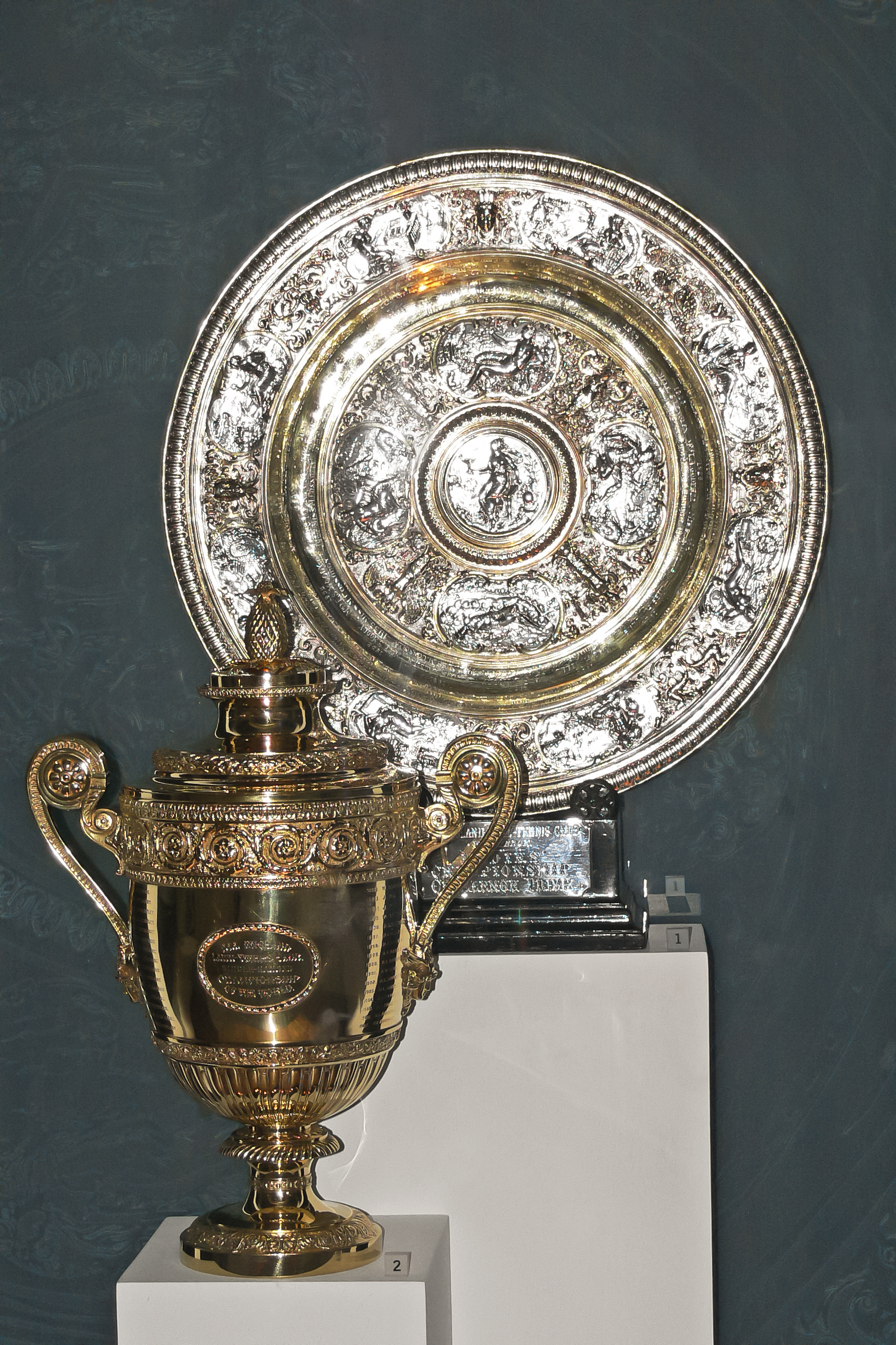
Wimbledon trophies.jpg by Benjamí Villoslada i Gil, via Wikimedia Commons, licensed under CC BY-SA 2.0. No changes made.