
Oil Priced in Gold: 1973 Again?
The Dollar is losing value, cheap oil remains vital...
WHEN I look at how things are going, I keep coming to the conclusion that we might see $10 per gallon gasoline at your local pump pretty soon – maybe in 2027, writes Nathan Lewis at New World Economics in this piece first published at Forbes.
It would cost $200 for a 20-gallon fillup. It might not happen, but if it did, it wouldn't surprise me a bit.
Basically, it would feel like a replay of the Oil Crisis of 1973. The basic reason for this is just the same as in 1973. Our currency, the Dollar, is losing value.
Already the penny is being disappeared, and I think the nickel is not far behind. It takes more and more Dollars to buy things. We had a burst of "inflation" following the wild money-printing of the Covid period, in 2020-2021, which combined with "supply chain" and other issues to drive prices higher. But, if you look on YouTube, or in our own experience and that of those we know, many Americans seem to be experiencing another, maybe even bigger inflationary burst as prices rise again.
Except for gasoline. It's still at a level that we first saw in 2008, eighteen years ago. Gasoline prices are very politically sensitive. We can't really have a public discussion about the price of a Big Mac, or apartment rent, or healthcare costs, because every situation is different. Gasoline prices are about the only price that is about the same everywhere, and every American knows what it is. It becomes a focal point for "inflation" that is affecting everything we buy.
Every politician around the world wants to avoid having a discussion about the "inflation" that is one of the characteristics of our time. President Donald Trump, in 2025, leaned hard on OPEC oil producers to increase their production to near maximum sustainable levels. For decades, OPEC has served as a regulator on the world oil markets, cutting back production when prices were low, and adding when prices were high. But Trump, promising oil at $50 per barrel, got OPEC to open the taps while prices were low, driving them still lower.
Most oil companies are not profitable at $60 oil. If prices stay here, they would go out of business, and oil production would quickly collapse. But, we're still driving cars, and using natural gas for electricity – more than ever – so that can't happen. Oil companies roll back their drilling schedule, because it doesn't make sense to add new production at these prices; and also, because they don't have the cash to do so anyway. Production falls.
In our 2022 book Inflation: What It Is, Why It's Bad, and How To Fix It, we said that the best (although not necessarily perfect) measure of the value of the Dollar, or any other currency, is its exchange rate with gold. In the past hundred years, whenever a currency's value fell significantly vs. gold (in other words, it took more currency to buy gold, or "the gold price went up"), signs of "monetary inflation" erupted soon afterwards.
This is what happened in 1973. It probably seemed, at the time, like everything was going great. The Federal Reserve was not engaged in any significant "money printing." Interest rates were not unusually low. But the value of the Dollar was collapsing vs. gold. It took 35 Dollars to buy an ounce of gold in 1970, at the end of the Bretton Woods gold standard era. In May 1973, it took about $100. The Dollar's value was about one third of its prior value, compared to gold. Just to catch up to this decline in Dollar value, oil prices had to triple.
This happened soon afterwards – touched off by the Arab Oil Embargo of 1973. OPEC had been complaining since 1971 that the Dollars that they were being paid for their oil were falling in value compared to gold. Maybe they used the 1973 Yom Kippur War as a cover to jack up prices. What we do know is that oil prices never fell afterwards, but instead soared higher again, in the inflationary burst of the late 1970s, finally touching $40 per barrel in 1980. If it was just a matter of a short-term supply shock, and there was no monetary inflation, prices would have later fallen back to their 1960s level around $3/barrel.
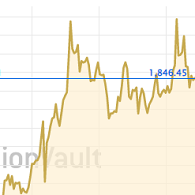
Recently, it has taken more and more Dollars to buy gold. The "price of gold" has risen, a lot – exactly what we warned, in our 2022 book, might be a sign of a whole new round of monetary inflation. In 2022, it took about $1800 to buy an ounce of gold. In January, this hit $5400 – three times higher. Just like May 1973.
Remember that today's supposed "oil glut" has come about because Trump pressured OPEC into opening the taps into a weak market. There's very little in reserve. If the physical oil market tightens up (because oil companies aren't drilling much), as oil analysts expect for the second half of 2026, there will be little OPEC can do about it. For the first time in sixty years, OPEC has nothing to offer.
These short-term considerations are happening against a more important backdrop of geological exhaustion. For nearly two decades, since 2009, the world has been using more and more oil – mostly the emerging markets. Nearly all of this additional oil has been supplied by the US Shale Miracle – the introduction of new "fracking" technology, and horizontal drilling, on a difficult resource that geologists knew about decades earlier. But, the US Shale fields look like they are reaching their maximum production right now. They will continue to produce at high levels, but even the Federal government's own Energy Information Administration admits that it looks like there will be no more additional production going forward from here.
The US Shale fields have been the only significant source of new petroleum production for the last 20 years. A decline in US production almost certainly means a persistent and continuing decline in global production, for the first time since modern petroleum drilling began in 1859.
It looks like a double-whammy: Both "monetary inflation factors" (declining currency value) and "non-monetary inflation factors" (supply-demand issues in the oil market) – using the terminology of our 2022 book – coming together in 2026 and 2027.





 Email us