
Silver and Gold Rebound on Trump's Hormuz Taco But ETFs Shrink 4% for the Month
SILVER and GOLD PRICES rebounded from 3-month and 4-month lows Monday lunchtime in London, almost reversing the morning's steep crash after major ETFs shrank yet again but oil then retreated and global stock markets rallied as US President Donald Trump withdrew his threat to attack Iran's energy infrastructure tonight, writes Atsuko Whitehouse at BullionVault.
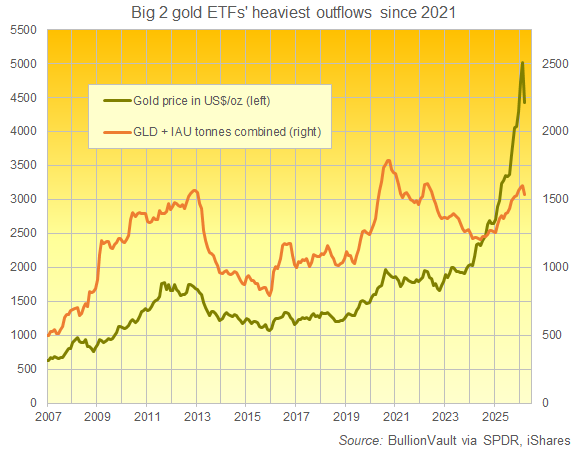
With the giant GLD and IAU gold-backed ETFs shrinking last week to their smallest combined size since November as shareholders liquidated stock, the price of gold plunged as low as $4100 this morning − down $400 per Troy ounce − as Asian stock markets sank more than 3.5% and European bourses lost 2.5%.
But Trump then took to his TruthSocial twitter platform in what some pundits called a classic 'Taco', claiming that the White House is having "in-depth, detailed and constructive conversations" with Tehran and extending the 48-hour deadline he gave Iran on Saturday to re-open the Strait of Hormuz to shipping by another 5 days.
Iran flatly denied there has been any "direct or indirect contact" with the United States, nor through any intermediaries.
Gold bounced within $10 per Troy ounce of the weekend's $4500 level, while silver reversed all of its 12.4% plunge to $61 per ounce.
That still put gold 15.9% lower from the start of the US-Israeli war on Iran a little over 3 weeks ago, while silver has now dropped 27.0% against the US Dollar.
"War is structurally deflationary for liquidity," says Nicky Shiels, head of metals strategy at Swiss refining and finance group MKS Pamp.
"Most conflicts deplete US Dollar [holdings], credit and liquidity − especially during an acute energy shock.
"Liquid assets including gold and precious metals are sold because illiquid positions cannot be."
Giant gold-backed exchange-traded trust fund (ETF) the SPDR Gold Trust (NYSEArca: GLD) ended Friday more than 4.0% smaller since the start of this Middle East conflict, while No.2 gold ETF − the iShares fund (NYSEArca: IAU) − had shrunk by 4.4%.
Together, that saw the 2 giant US-listed gold ETFs liquidate 66.3 tonnes of bullion so far this month − the largest tonnage decline since March 2021 − to head for their first net monthly outflow since May 2025.
Silver's giant bullion-backed ETF the iShares Trust (NYSEArca: SLV) has also reduced its holdings by 4.7% since the conflict started, shrinking by Friday's New York close to the smallest since November.
This morning's crash in the price of London silver bullion took the industrially-useful precious to exactly half its record peak of end-January, when it topped $121 per Troy ounce.
Silver prices then rebounded with gold and Western stock markets as crude oil tumbled nearly 8.0% following Trump's tweet.
But that still kept the cost of oil 36.9% above its level of 27 February, eve of the US and Israel attacking Iran, while European natural gas futures for April − also sharply lower following Trump's delay today − held nearly 70% higher as output of liquefied natural gas from Qatar remained 1/5th lower thanks to Iran striking its giant Ras Laffan facilities.
Interest-rate expectations also stayed elevated, with betting on US Fed Funds rates putting barely a 1-in-10 chance on the US central bank cutting the cost of borrowing before the end of 2026.
That was seen as a 96% certainty on the eve of the war, and it remained the consensus forecast from US Fed policymakers themselves in last Wednesday's updated 'dot plot' economic forecasts.
"The 'TACO regime' in US stocks, where every selloff was a buying opportunity, may be over," said a Bloomberg News column overnight, before the latest about-turn by the President, now widely known as 'Trump always chickens out'.
"The 'TACO' trade, where investors expect President Donald Trump to back down from an aggressive stance due to a market selloff, is looking suspect," agreed a separate column from MarketWatch.
Losing 14.5% by 10:30am from last Monday morning in London, the price of gold today showed its steepest 5-session loss since the end of February 1983.









 Email us