
Oil Up, Gold Down Again as Iran, Ukraine and AI-Trade Wars Intensify
GOLD and SILVER again fell as crude oil rose on Wednesday, both trading 1.8% lower for the week so far as interest-rate forecasts rose and Western stock markets fell amid a sharp escalation of the US-Iran and Russia-Ukraine wars.
Israel continued its invasion of southern Lebanon, bombarding the city of Tyre.
China's Communist leadership condemned maritime boundary talks between Japan and the Philippines, as did the Government of "breakaway" Chinese republic Taiwan, whose waters the current boundaries border.
"The latest hostilities have pushed oil prices higher," says a trading note from London bullion clearing bank ICBC Standard, part of China's giant ICBC bank.
"Adding to global inflationary pressures, [that means] expectations for a Federal Reserve rate hike have increased and the US Dollar strengthened, exerting pressure on non-yielding, dollar-denominated gold."
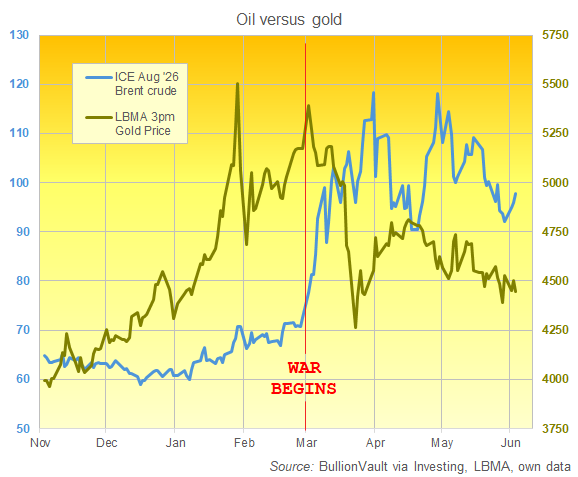
With the ICE derivatives exchange's August Brent crude contract rising 1.2% today, the price of gold in London fell 1.3% to fix around $4445 per troy ounce at the City's 3pm auction.
Since the current Middle East war began with US and Israel attacking Iran at the end of February, the price of gold has gone in the opposite direction to the price of oil 58.2% of the time day-to-day on BullionVault analysis.
That compares to just 38.8% of the time over the preceding 3 months.
"They've already agreed they're not going to have a nuclear weapon," said US President Trump overnight, claiming that Iran needs to make a deal because it now "has no navy...no air force...very few soldiers...no leadership. Their economy is crashing. They have 250% inflation."
But after the US hit Iranian military sites near the still-closed Strait of Hormuz late Tuesday, Iran fired missiles and drones at US military locations across Kuwait and Bahrain, also hitting Kuwait's international airport and killing at least one person while injuring over sixty.
"These responses should serve as a lesson," said a statement from Iran's Revolutionary Guard, warning of a "heavy price for the aggressive US military" as pro-Palestinian hacker group Handala − believed to be backed by Tehran's Ministry of Intelligence − said it supplied the IRGC with the target data.
Global stock markets slipped 0.4% from yesterday's fresh record high on the MSCI World Index, but shares in search-engine monopoly Alphabet (Nasdaq: GOOG) rallied at the New York opening after losing 3.9% on yesterday's announcement of an $80 billion equity raising − half to fund AI spending, half for staff options awards tax, with $10bn coming from legendary investor Warren Buffett's Berkshire Hathaway.
The largest capital markets event in history, Alphabet's cash raise tops the likely $75bn IPO expected from tech billionaire Elon Musk's SpaceX as early as next week.
Silver prices meantime fell back through $74 per troy ounce as the rise in oil prices saw betting strengthen that the US Federal Reserve will raise its key interest rate before the end of this year.
Base metal copper also dropped back, losing 2.1% from yesterday's fresh record high on Nymex futures contracts.
Over in Europe, attendees of the St.Petersburg International Economic Forum − widely dubbed the "Russian Davos" − today met against a backdrop of firefighters tackling a huge blaze at the city's oil terminal as drones fired by Ukraine also struck the nearby Kronstadt naval base.
While data from the Central Bank of Russia shows the former No.1 gold buyer selling down its bullion reserves as the Ukraine war continues, the Reserve Bank of India today refuted analysis from Bloomberg showing that Mumbai has been selling gold bullion to try defending the Rupee − a response widely derided by other analysts on social media.
Already fighting to reduce foreign currency outflows by hiking import duty on bullion, India's Government yesterday tightened other rules on the import of silver, adding grain and powder − needed for technological uses of silver such as PV solar panels − to its list of "restricted" items requiring prior authorization from the Directorate General of Foreign Trade.
With US lawmakers lambasting the Trump administration for "allowing" the export to foreign nations of AI chips, even as the White House moves to block AI giant Nvidia (Nasdaq: NVDA) from selling to China, the European Commission today launched a proposal "to strengthen the EU's digital autonomy" by building new "capacity in semiconductors, artificial intelligence (AI), cloud and open source."
"We need to increase air monitoring and air defence capabilities throughout Nato's eastern flank," said Oana Toiu, foreign minister of military alliance member Romania after a Russian drone last week struck an apartment block in the town of Galati, some 20 kilometres from Romania's border with Ukraine.










 Email us