
Gold Sinks on US-Iran Talks as Central Bank Buying and Price Forecasts Revised
GOLD PRICES sank on Wednesday, dropping more than $120 per ounce to the cheapest since late-March's 4-month lows despite talk of a US-Iran peace deal sending oil prices, bond yields and US Fed rate-hike expectations sharply lower, suggesting that the selling pressure in gold may be coming from central banks.
Industrially useful silver and platinum fell to 1-week lows while palladium prices edged higher.
Global stock markets meantime held little changed overall from yesterday's fresh record high on the MSCI World Index, with a drop in Asia offset by a rise in European bourses and New York equity index futures.
"The recent gold sell-off increasingly resembles forced sovereign liquidity management during an oil shock rather than the end of the long-term bull market," said derivatives trader Stephen Innes ahead of Wednesday's price slump.
"Falling growth expectations and an eventual return toward dovish central bank policy could reverse the yield pressure that initially hurt bullion."
Yet today's slump in the gold price − down as low as $4406 per troy ounce − came as betting that the Federal Reserve will start raising interest rates from December slipped back to the weakest in almost 2 weeks according to data from the CME derivatives exchange's FedWatch tool.
Longer-term rates in the bond market also hit the lowest in a fortnight on 10-year US Treasury debt, with UK Gilt and German Bund yields hitting 5-week and 7-week lows respectively.
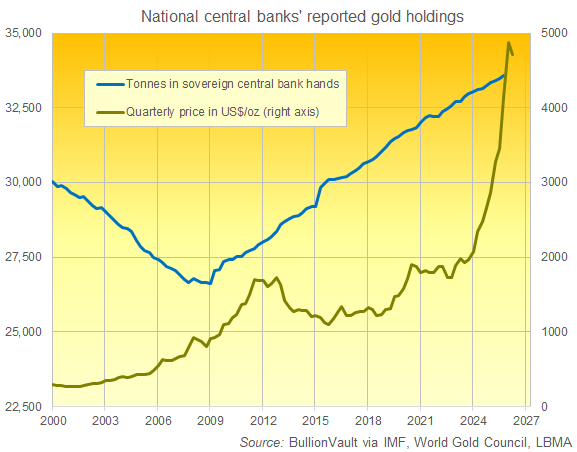
The central-bank sector worldwide was a net buyer of nearly 244 tonnes of gold between January and March according to the latest estimate from mining-industry group the World Gold Council.
But available data published by central banks themselves showed net liquidation of 102 tonnes across the first quarter, led by March's war-time dash for cash and currency market intervention by Turkey.
With the central bank of Russia continuing to sell gold in April, that outflow for Q1 − if confirmed when final data are in − would take sovereign gold reserves reported to the IMF back below 33,500 tonnes from the multi-decade record set at end-2025, snapping a 2.5-year unbroken run of quarterly growth.
"[Emerging-market central banks are] likely to continue the structural diversification of their reserves into gold," reckon analysts at US investment bank and London bullion market maker Goldman Sachs, repeating their year-end 2026 gold price forecast of $5400 per ounce and estimating that central banks as a group are buying twice as much bullion as they previously thought, running to 60 tonnes per month on average.
Goldman's update to its central-bank gold demand 'nowcast' is based on tracking "the discrepancy between London vault outflows and UK net exports as unrecorded sovereign gold flows," say analysts Lina Thomas and Daan Struyven.
Latest data from the Bank of England − the world's No.2 custodian of foreign central bank gold behind the New York Fed − show its vaults holdings 5,436 tonnes at end-April, the most since summer 2022.
London's commercial vaults have also added gold so far this year, albeit with a 1.2% net outflow last month from March's 41-month high of 3,983 tonnes.
"Markets are rediscovering the concept of opportunity cost," counters analysis from Swiss bank and London bullion clearing member UBS, cutting its year-end gold price forecast from $5900 to $5500 because "gold's non-yielding characteristics [are] once again becoming a more important consideration as real interest rates remain elevated."
Like gold, crude oil prices also fell sharply on Wednesday, snapping the past 3 months' prior disconnect and dropping through $90 per barrel of US benchmark WTI after Iranian media said the Revolutionary Guard plans to restore full oil tanker access through the Strait of Hormuz within one month of a formal peace deal, something US President Trump is today meeting with his Cabinet to discuss.
US ally Israel meantime told the 125,000 population of Tyre in neighbouring Lebanon to evacuate immediately before it bombs the city in its campaign against the Iran-backed Hezbollah political and military group.









 Email us