
$35,000 Attack Drones and Trump's $1.5 Trillion
Defense investment surges on AI...
THIRTY-FIVE thousand dollars, says Frank Holmes at US Global Investors.
That's the cost of the Pentagon's new Low-cost Uncrewed Combat Attack System − LUCAS for short.
It made its combat debut this year in the conflict with Iran. Reverse-engineered from Iran's Shahed drone design, the LUCAS is autonomous, long-range and capable of swarm strikes, all for about the price of a midsize pickup truck.
To put that in perspective, a Tomahawk cruise missile runs about $2.5 million. A Patriot interceptor? Around $4 million per shot.
I've long believed that government policy is a precursor to change, and right now, policy, geopolitics and technology are converging in a way I haven't seen in my entire decades-long career in capital markets.
What's emerging is a new defense-industrial revolution built on artificial intelligence (AI) and autonomy.
Let's start with the macro picture because the numbers are staggering. President Donald Trump's proposed 2027 budget calls for $1.5 trillion in defense spending, by far the largest Dollar amount in modern American history.
That includes $1.1 trillion for the Defense Department and another $350 billion earmarked for critical munitions and rebuilding the US defense industrial base.
Tucked away in that $1.5 trillion figure is a line item I find especially interesting: $13.4 billion for "autonomy and autonomous systems." In other words, drones and unmanned vehicles, not to mention the AI data centers that run them.
This tells me the Pentagon has acknowledged that the nature of warfare has fundamentally changed, and that the side with the smartest, cheapest, most numerous machines will have the upper hand.
Defense Secretary Pete Hegseth has already directed the Army to deploy drones in every division and to dramatically expand counter-drone capabilities by 2027. Meanwhile, the Air Force's Collaborative Combat Aircraft (CCA) program is on track to spend nearly $9 billion building AI "wingmen" to fly alongside our F-22s and F-35s.
When the world's largest customer commits this kind of capital, I believe smart investors should take note.
Many analysts are already calling Operation Epic Fury the first real AI war, and with good reason. In just the opening weeks of fighting, close to 2,000 drone strikes were recorded. US Central Command confirmed that "hundreds" of US attack drones were deployed.
Meanwhile, Ukraine's drone production has exploded from roughly 800,000 units in 2023 to nearly 5 million projected for 2026. In March, for the first time, Ukraine actually launched more cross-border attack drones than Russia did. It amazes me that a country that had essentially no domestic drone industry four years ago is now out-producing one of the world's traditional military superpowers.
In this new AI era, the math has flipped. As one analyst put it, using a Patriot missile to shoot down a $35,000 Shahed costs the US 100 times more than its costs Iran. That asymmetry is why every major military on the planet is scrambling to retool around cheap, smart, autonomous weapons.
And it's not just offense. Israel's new Iron Beam laser system, which saw its first use in combat last month, can knock incoming rockets out of the sky for about $2.50 per shot, compared to $50,000 or more for a traditional Iron Dome interceptor. AeroVironment's Locust X3 laser counter-drone system, unveiled just last month, is reportedly even cheaper.
Investor demand for aerospace and defense is surging at the moment, judging by inflows.
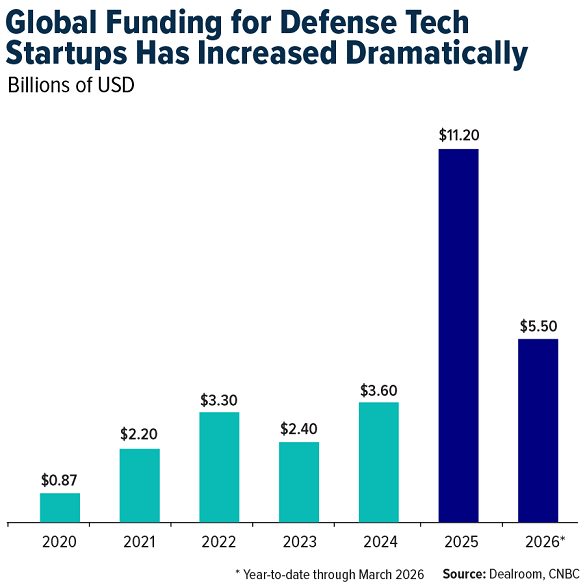
In 2020, the entire global defense-tech venture capital sector raised just $869 million. Last year, that figure hit $11.2 billion, a more than tenfold increase in five years, according to Dealroom data.
On the public markets side, aerospace and defense ETFs pulled in a record $3 billion of net inflows last month alone, the biggest monthly haul ever recorded for the category. I don't believe this is a one-month blip.
Look at what's happening to the new generation of defense-tech firms. Palantir, the data-and-AI company, now has a market cap north of $300 billion, down from its peak of $475 billion at the end of October 2025. That puts the Miami-based firm ahead of traditional defense giants such as Lockheed Martin and RTX (formerly Raytheon).
Indeed, President Trump posted about Palantir, writing that the company "has proven to have great war fighting capabilities and equipment."
Anduril, the autonomous systems startup founded barely a decade ago, just closed a funding round at a $60 billion valuation, doubling for the second year in a row. According to Brennan Center research, Anduril's revenue has been compounding at a median annual growth of 143% per year, making it the fastest growing major defense contractor.
And then there's SpaceX, which has reportedly filed confidentially for what could be the largest IPO in history, at a valuation potentially pushing $1.75 trillion. That's thanks in large part to its satellite contracts with the Pentagon.
The best investment opportunities often arise when three forces are in sync: 1) a powerful policy tailwind, 2) a genuine technological breakthrough and 3) a real-world use case.
Today, in defense tech, all three are flashing green at the same time.
I encourage every reader to do their own homework before making any investment decisions, but when the White House is seeking $1.5 trillion, when ETF flows hit record highs, and when the cost of fighting wars is being rewritten by $35,000 drones, I believe investors should take note.









 Email us