
Gold Nears Record High as EU Borrows to Fund Ukraine, Bond Yields Jump
GOLD held strong as bullion trading closed this week, slipping only 0.5% from last Friday's record weekend finish in London as Western government financing costs rose after the European Union agreed to borrow and spend its own money supporting Ukraine's fight against Russia, rather than tapping frozen Russian assets.
While Washington's 10-year Treasury yield rose slightly from a 2-week low, Tokyo's 10-year Japanese government bond yield hit 2.0% − its highest so far this century − after the Bank of Japan raised overnight interest rates to the highest in 3 decades at 0.75% as new prime minister Sanae Takaichi pushes for a large fiscal stimulus.
Germany's 10-year Bund yield meanwhile tested its highest since 2011 at 2.89% per annum, contrasting with annual deflation of 2.3% in the No.1 Euro economy's latest producer price index.
German central bank the Bundesbank today projected that the Berlin government's budget deficit will hit nearly 5% by 2028, the worst since the post-reunification recession 3 decades ago.
"Debt-financed stimulus is how Japan ended up with government debt at 240% of GDP," says economist Robin Brooks of the US Brookings Institution.
"A desperate search for safe havens is underway, which is what the 'debasement trade' is all about."
Since Moscow's all-out war on Ukraine led to asset freezes and sanctions from the UK, Europe and the US in early 2022, gold has broken its long-time relationship against real rates of interest, rising as the cost of borrowing adjusted by inflation has also increased.
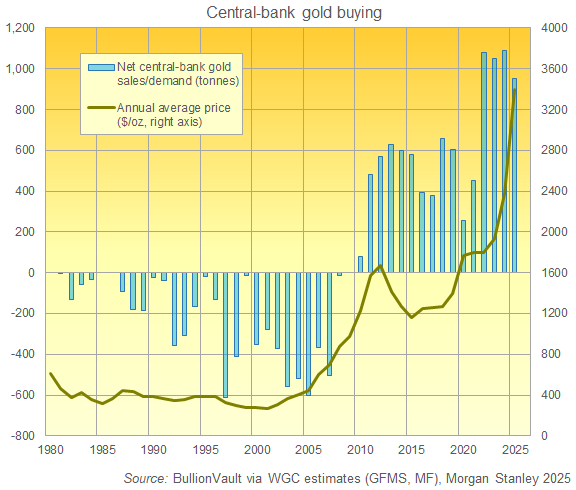
Gold demand from central banks as a group has meanwhile leapt, with estimates for the mining industry's World Gold Council putting the official sector on track for 850 tonnes of net gold purchases in 2025, down by only 1/10th from the past 3 years' historic highs despite this year's near-record gold price surge.
Analysts at US bank Morgan Stanley now estimate 2025 official sector demand at 950 tonnes, almost 3 times the figure publicly reported by central banks themselves year-to-date, and equal to more than 1/4 of annual global gold mining output.
"Many other countries also keep their gold and currency reserves in Europe," noted Moscow's President Vladimir Putin in his annual 'Results of the Year' media show today, warning that the region's financial centres risked "severe consequences" if Russian assets frozen at the Euroclear exchange in Belgium had been used to finance Ukraine's defense against his 4-year long invasion − a proposal which failed to pass on Thursday.
Instead − and with the Moscow-friendly leaders of Hungary, Slovakia and now the Czech Republic agreeing not to block the deal − the European Union's other member states voted to raise €90 billion in new debt from the bond market, lending the cash to Kyiv without any backstop from either the €210bn of frozen Russian assets or the European Central Bank.
"We are an area of the world which praises itself for respecting the rule of law," said ECB President Christine Lagarde on Thursday.
"You cannot expect me to validate a mechanism under which there would be monetary financing" of EU member states by the Eurozone central bank − a move explicitly barred by the single currency's founding treaty.
"While gold does not generate income and its protective behavior is not guaranteed in every downturn, we still believe a modest allocation can enhance diversification and buffer against systemic and geopolitical risks," says a note from the investment advisors at Swiss bank and London bullion clearers UBS, recommending "a mid-single-digit percentage" in gold.
That contrasts with this year's rush to hike recommended gold allocations among other US banks, with Morgan Stanley suggesting 20% and Bank of America recommending 25%.
Gold in London − the world's central bullion trading and storage hub − yesterday spiked within $10 of mid-October's spot market peak, trading at $4374 before dropping back to $4334 per Troy ounce today.
Silver meantime recovered all of last night's $2 drop to near Wednesday's fresh all-time highs above $66.85 per ounce.
Platinum and palladium also rallied back near yesterday's new multi-year highs, trading at $1965 and $1700 per ounce respectively, after dipping when the Guangzhou Futures Exchange in China responded late Thursday to surging trading volumes in its new Pt and Pd contracts by limiting the size of new positions.
Trading volumes on the GFEX in palladium still topped a new record of 105,000 contracts and platinum matched yesterday's peak above 150,000 despite the new daily cap of 500 additional contracts put on non-member traders.
Gold bullion on the Shanghai Gold Exchange showed a discount to London quotes of $22 per ounce, suggesting weak demand versus supply in the precious metal's No.1 mining, importing and consumer nation.
Silver trading volumes rebounded on both the SGE and the Shanghai Futures Exchange as, like gold, the price in Yuan terms edged lower as the Chinese currency hit 15-month highs against the Dollar.
Gold discounts in No.2 consumer India widened to $34 per ounce versus London quotes once import duty and VAT sales tax are included.
"Indian gold demand has displayed exceptional resilience in 2025 despite the rupee price rising by more than 50% during the first nine months," says analysis from specialist consultancy Metals Focus.
"We expect this resilience to persist into 2026. However, this outcome will reflect a [continued] divergence between jewellery and retail investment, with weakness in the former largely offset by strength in the latter."
A plunge of over 90% in Swiss gold exports to India and a 40% plunge to France were offset last month by a sharp rise in flows to China and, most dramatically by weight, into the UK.
Both the head of Euroclear and the Prime Minister of its home nation Belgium received physical threats from Russian agents over the EU's plan to use Moscow's frozen assets to fund Ukraine.
Both also pushed back against it.









 Email us