
Iran War Spurs Gold's Worst Price Drop Since 2013 Crash as ETFs Shrink, Central Banks Sell
The PRICE of GOLD extended the past week's rally from 4-month lows on Tuesday, but the worsening Middle East conflict saw it head for its worst 1-month plunge since the crash of spring 2013 as gold-backed ETF investment funds showed their heaviest liquidation in nearly 4 years.
"Using gold-backed transactions during periods when foreign exchange liquidity needs to be supported is a perfectly natural choice," said Central Bank of Turkey governor Fatih Karahan today, commenting on the CBRT's mobilization of 60 tonnes of gold reserves since US-Israeli war on Iran began on the last day of February.
"The combination of central banks potentially turning into net sellers without flows from physically backed gold ETFs would continue to put pressure on the metal until at least the first half of this year," says analysis from French investment bank Natixis.
With Brent crude making its sharpest 1-month jump since oil's Covid Crash rebound of May 2020, the price of gold today headed for its steepest 1-month drop since June 2013 and gold's worst-ever performance during the first month of a major conflict in at least 5 decades.
Liquidation by gold ETF shareholders has meantime caused the heaviest 1-month outflows from the sector since September 2022 according to data compiled by the mining industry's World Gold Council, shrinking by almost 90 tonnes over the 4 weeks ending last Friday.
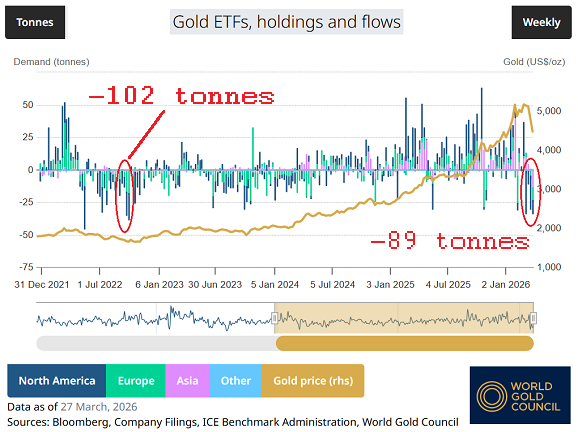
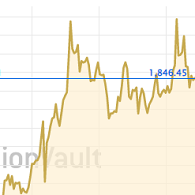
Despite losing 12.3% this month to $4578 per Troy ounce, gold bullion still showed its 5th quarterly price rise in a row on Tuesday, adding 6.3% from New Year's Eve.
That marks the longest such stretch of gold price rises since the 9 calendar quarters of gains made between Q4 2018 and Q4 2020.
"It is time to review the uniform definitions and include gold as a HQLA," says a new lobbying website from the World Gold Council and the bullion market's LBMA, continuing their joint push for financial regulators to recognize gold as a 'high quality liquid asset' on commercial bank balance sheets.
"This advocacy is not simply to benefit the gold industry," says the new site, providing data and analysis of gold's performance, low risk, high liquidity and low volatility.
"The use of gold within the prudential regulatory system could be part of the solution for future adverse financial liquidity events and other forms of systemic risk, as demonstrated during the Covid-19 and the 2023 US banking crisis."
Selling and borrowing against some of its gold to raise cash for defending the Lira, Turkey is applying "proactive, flexible, and controlled" management of its central bank reserves, said the CBRT's Karahan today.
"Going forward," says Natixis, "we think that the more long-term damage to regional energy infrastructure occurs, the more likely it is that we see central banks swapping or outright selling gold...to shore up their country's finances...as they focus on managing the repercussions of higher inflation, weaker currency and lower growth."
Silver priced in Dollars meantime showed a 19.3% loss for March at today's 12 noon auction in London, marking its steepest monthly drop since September 2011 at $72.70 per Troy ounce.
Giant silver-backed ETF the iShares trust (NYSEArca: SLV) has shrunk 4.4% by weight this month, taking its total liquidation by weight to more than 1,155 tonnes so far in 2026.
That's equivalent to almost 1/5th of global silver mining output over the first quarter of the year.
Investor liquidation of gold's giant SPDR ETF (NYSEArca: GLD) has meanwhile shrunk the GLD trust fund 5.0% by weight this month to need the smallest bullion backing since the end of November at 1,046 tonnes.









 Email us