
Fresh Friday Highs for Gold and Silver as Central Banks Attack Trump's 'Populism'
GOLD held steady but silver slipped on Friday, both setting fresh record week-end prices in Shanghai, London and New York as US President Trump threatened to send in the military against anti-ICE protests while foreign central banks protested the criminal investigation of Federal Reserve chairman Jerome Powell.
"In 1971 Nixon took the world off the gold standard. Today Trump is taking the world off the Dollar standard," The Times of London quotes UK fund manager George Cooper of Equitile Investments.
But following Monday's initial plunge on the FX market following news of Powell's subpoena by the Department of Justice, the Dollar today traded unchanged for the week.
New data meantime said that while world No.1 foreign-reserves holder China cut its position in US Treasury bonds in November, other foreign holders of Washington's Dollar debts grew their exposure to a new all-time record above $9.3 trillion.
That year-on-year rise of 7.2% was led by the government of Japan, plus investors using the UK and Belgium for custody, likely including other central banks and sovereign wealth funds.
"Sovereign wealth investors should review their portfolios," the Financial Times today quotes a US tax advisor after the Trump White House proposed removing a tax exemption for SWFs investing in commercial bonds and loans.
Gold bullion today fixed around $4610 per Troy ounce at London's 3pm auction, a rise of 2.6% from last Friday and the 5th new week-end record since the start of December.
Silver prices had fixed close to $91 per ounce at midday, but the more industrially-useful precious metal then sank to $87 in late-London trade.
That cut silver's week-on-week jump from 16.1% to 11.3%, still recording its 7th new all-time Friday high in a row.
Silver in Shanghai had earlier eased from a massive $11 per ounce premium over London quotes to a $10 gap, still reflecting "extreme stress" in supplies in the precious metals' major consumer-and-export nation amid a speculative rush which today saw the Shanghai Futures Exchange more than halve the maximum number of new opening positions per day, effective Tuesday.
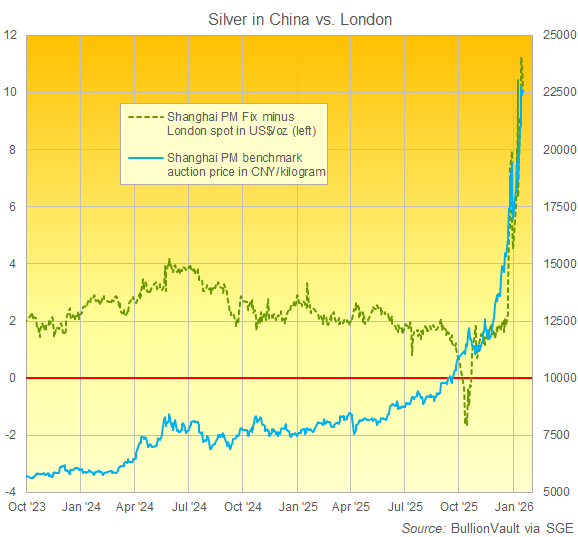
"Soaring commodity prices impose irresistible cost pressure on solar manufacturers," says Bloomberg New Energy Future analyst Yali Jiang, signaling a likely hit to demand from silver's now crucial industrial use in the photovoltaic sector.
"As silver stocks in London continue to recover and Chinese silver exports remain in-line with previous years," says specialist consultancy Metals Focus, "the dislocation in the silver market is likely to ease gradually," with prices already retreating this week after US President Trump "postponed imposing tariffs" on silver and other 'critical minerals'.
Besides deciding not to tariff US silver imports in Wednesday's critical minerals announcement, Trump this week called for a 10% cap on US credit card interest rates, half the current average. Shares in American Express (NYSE: AXP), Visa (NYSE: V) and Mastercard (NYSE: MA) have since lost more than 6%.
Trump yesterday promised $2,000 checks for Americans to spend on health insurance, with shares in healthcare insurers led by UnitedHealth (NYSE: UNH), Elevance Health (NYSE: ELV) and Cigna (NYSE: CI) rising up to 2% and more.
Trump this week also denied previously promising $2,000 checks as a 'dividend' from his import tariffs; denied any prior knowledge of the criminal investigation into Fed chair Jerome Powell; threatened to invoke the Insurrection Act to send US military against immigration protests in Minnesota; and said he may cut Exxon (NYSE: XOM) out of investing in Venezuela's oil industry for being "cute" at a White House meeting.
The next day, Exxon's stock rose to a new all-time record, outperforming competitors Chevron (NYSE: CVX) and ConocoPhillips (NYSE: COP) with a 4.8% rise since last weekend.
"If I had the help of the Fed, [my job] would be easier, but that jerk will be gone soon," said Trump of Fed chair Powell in a speech to the Detroit Economic Club in Michigan this week.
For central bankers, "The rise of so-called populism makes the whole task harder," said UK Bank of England governor Andrew Bailey today, decrying the breakdown of the "international rules-based system.
"Populism [is] encouraging a decline in trust [in] institutions – domestic and international – [now] viewed as distant, unresponsive and acting for the benefit of powerful and uncontrollable interests," Bailey told the Bellagio Group of central bank policymakers, finance ministry officials, academics and staff from international bodies the IMF, BIS, and OECD, all meeting at the Bank of England.
"We have to challenge back, in deeds more than just words."
But "we remind the Governor to stay in her lane and stick to domestic monetary policy," said New Zealand's foreign minister Winston Peters on social media this week, rebuking the Reserve Bank's new leader Anna Breman for signing a joint letter with the BoE, European Central Bank and more than a dozen other central banks and international bodies expressing "full solidarity" with Jerome Powell against the DoJ investigation.
"The RBNZ has no role, nor should it involve itself, in US domestic politics."
For silver, easier liquidity conditions "may introduce some short-term price downside," says Metals Focus, "but in our view this downtown will be quickly absorbed by investors, resulting in further upside for the silver price over the foreseeable future."
As for gold, "We see bullion reaching $5000 in the coming months amid [investment] hedging demand stemming from ongoing macroeconomic, policy, and geopolitical concerns," says Swiss banking giant and London bullion clearer UBS.









 Email us